

Dubai Mainland Company Setup Guide: Complete 2026 Process, Costs & Requirements
Starting a business in the UAE is one of the most attractive moves any entrepreneur can make, and for many founders the first real decision is where to register. A Dubai mainland company setup gives a business the freedom to trade anywhere in the UAE, bid for government contracts, and open branches across the country without the restrictions that come with a free zone license. This guide walks through everything involved in a Dubai mainland company setup: what mainland actually means, how the licensing process works, what it costs, which documents you need, and how office space requirements fit into the picture. Whether you are a first-time founder or an established business relocating to the UAE, this Dubai mainland company setup guide is built to answer the questions that actually come up during registration.
Table of Contents
What Is a Mainland Company in Dubai?
A mainland company, sometimes called an “onshore” company, is a business licensed by the Dubai Department of Economy and Tourism (DET), formerly known as the Department of Economic Development (DED). Unlike a free zone entity, a mainland company is not confined to operating within a specific zone or jurisdiction. It can sign contracts with private clients and government entities anywhere in Dubai and the wider UAE, rent office space in any commercial building in the emirate, and take on public sector tenders that free zone companies are not eligible for.
Understanding this distinction early is the foundation of any successful Dubai mainland company setup, since it shapes every decision that follows — from license type to office location to long-term expansion plans. A Dubai mainland company setup also allows unrestricted access to the local market. This matters enormously for retail brands, consultancies, contractors, logistics providers, and any business that depends on face-to-face dealings with UAE-based clients. Since reforms in recent years, most business activities now permit 100% foreign ownership on the mainland, removing the old requirement for a UAE national sponsor to hold the majority share in most sectors. A short list of strategically sensitive activities, mostly in oil, banking, and security, still require Emirati participation, but the overwhelming majority of trading, professional, and industrial licenses fall outside that list.
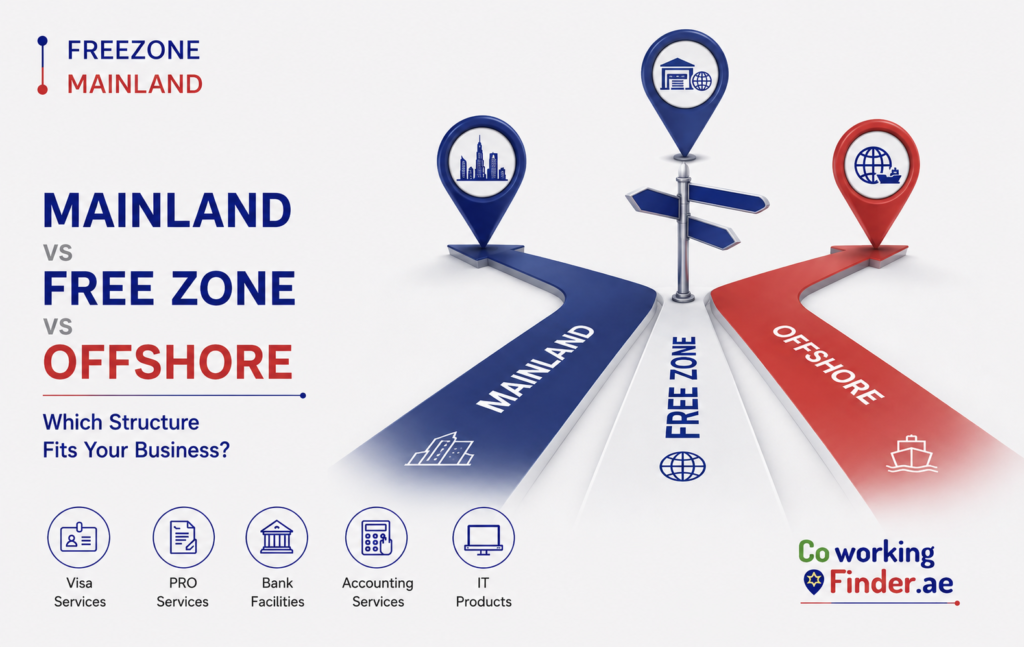
Mainland vs Free Zone vs Offshore: Which Structure Fits Your Business
Choosing between mainland, free zone, and offshore is the single most important decision in any UAE company formation, and it depends entirely on where and how you plan to do business.
| Feature | Mainland | Free Zone | Offshore |
| Market Access | Trade anywhere in UAE and internationally | Trade within free zone and internationally; UAE mainland trade needs a distributor | No UAE trading permitted |
| Ownership | Up to 100% foreign ownership for most activities | 100% foreign ownership | 100% foreign ownership |
| Office Requirement | Physical office with Ejari mandatory | Flexi-desk or physical office depending on package | No physical office required |
| Government Contracts | Eligible | Not eligible | Not eligible |
| Visa Eligibility | Based on office size | Based on package / flexi-desk allowance | Not eligible |
| Setup Cost | Moderate to higher, includes office cost | Lower entry packages available | Lowest |
If your business model depends on serving UAE-based clients directly, opening retail stores, running a restaurant, providing on-site services, or competing for government tenders, a Dubai mainland company setup is the only structure that supports all of it. If you are building an export-focused, holding, or purely online business with no local trading, a free zone or offshore structure may work out cheaper and faster to establish.
Why Choose a Dubai Mainland Company Setup: Key Benefits
There are several reasons founders choose mainland over free zone once they understand the trade-offs involved in a Dubai mainland company setup.
- Unrestricted trading across the UAE — a mainland license lets you open multiple branches, sell directly to consumers anywhere in the country, and work with clients in any emirate without a local distributor or agent.
- Eligibility for government tenders — public sector projects, infrastructure tenders, and many large corporate contracts are only awarded to mainland-licensed companies.
- No fixed limit on employee visas — visa allocation is tied to your office size rather than a capped package, so a growing team is not blocked by a visa quota.
- Wider choice of business activities — the DET activity list covers thousands of commercial, professional, and industrial activities, and a single license can often combine several related activities.
- Easier access to local banking — UAE banks are generally more comfortable opening accounts for mainland companies with a real UAE office address and Ejari.
- No currency restrictions — mainland companies can repatriate 100% of profits and capital, hold multi-currency accounts, and operate without foreign exchange controls.
Taken together, these advantages explain why a Dubai mainland company setup remains the default choice for businesses planning serious, long-term operations inside the UAE rather than a purely offshore or export-driven presence.
Step-by-Step Dubai Mainland Company Setup Process
The Dubai mainland company setup process generally follows the same sequence regardless of your business activity, though the paperwork varies by sector. Below is the full Dubai mainland company setup sequence from activity selection to visa issuance.
- Choose your business activity and legal structure — the DET activity list determines your license type (commercial, professional, industrial, or tourism) and whether you need an LLC, sole establishment, civil company, or branch of a foreign company.
- Reserve your trade name — your company name must comply with UAE naming conventions, avoid religious or political references, and not duplicate an existing registered name.
- Apply for initial approval — this confirms the government has no objection to you starting the business, though it does not yet authorize you to begin operating.
- Draft the Memorandum of Association (MOA) — for LLCs and civil companies, the MOA outlines shareholding, activity scope, and management structure, and must be notarized.
- Secure your office space and Ejari registration — every Dubai mainland company setup requires a registered tenancy contract tied to your license, whether a private office, a serviced office, or a flexi-desk arrangement.
- Submit final documents and pay license fees — once the office lease, MOA, and approvals are in place, submit the complete file to DET and pay the applicable fees.
- Receive your trade license — once approved, DET issues the trade license, and you can proceed to open a corporate bank account and apply for visas.
- Apply for the Establishment Card and visas — the Establishment Card from GDRFA allows you to sponsor employee and investor visas linked to the company.
Business Activities and License Types for Mainland Companies
A Dubai mainland company setup falls into one of four broad license categories, and choosing correctly at the start avoids delays later.
- Commercial License — covers trading, retail, import-export, and general buying and selling of goods.
- Professional License — covers consultancies, IT services, marketing agencies, legal and accounting practices, and other service-based activities.
- Industrial License — covers manufacturing, processing, and any activity involving the transformation of raw materials into finished products.
- Tourism License — covers travel agencies, tour operators, and hospitality-adjacent services, regulated jointly with DET.
Many founders combine multiple related activities under a single license during their Dubai mainland company setup, which reduces the need for separate registrations as the business diversifies. It is worth listing anticipated future activities early, since amending a license later involves additional fees and processing time.
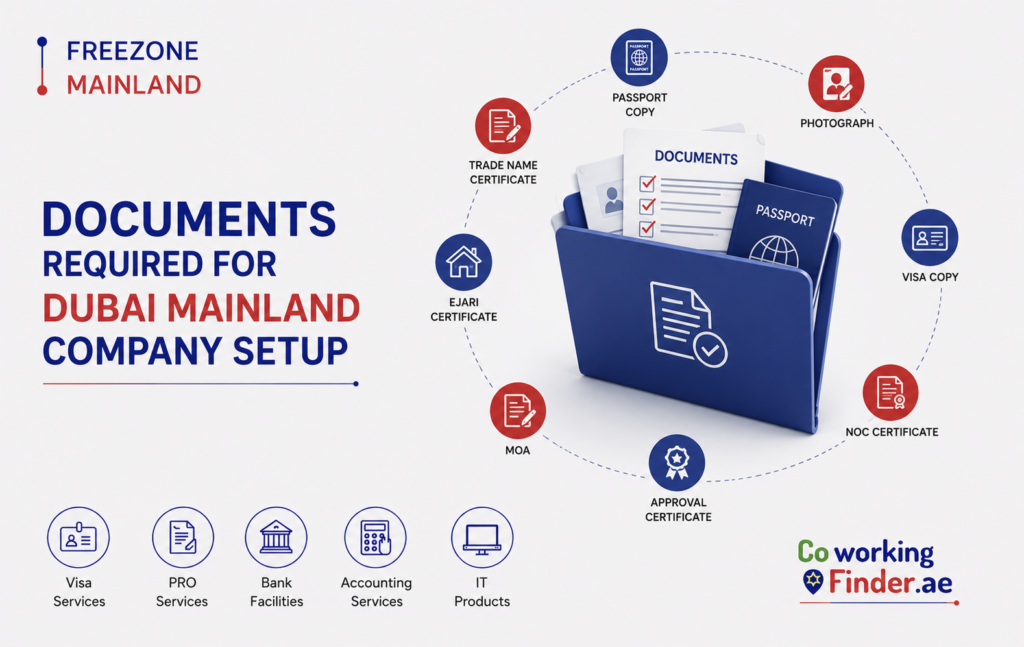
Documents Required for Dubai Mainland Company Setup
Requirements vary slightly by activity and nationality, but a standard Dubai mainland company setup file typically includes the following:
- Passport copies of all shareholders and the appointed manager
- Passport-size photographs with a white background
- Entry stamp or UAE residence visa copy, if applicable
- No Objection Certificate (NOC) from a current UAE sponsor, if the applicant is already a resident
- Initial approval certificate from DET
- Notarized Memorandum of Association
- Ejari certificate or tenancy contract for the registered office
- Trade name reservation certificate
- Board resolution or power of attorney, for corporate shareholders
Consultants and PRO service providers typically handle document attestation and submission on the client’s behalf, which shortens the overall Dubai mainland company setup timeline considerably. Keeping digital and physical copies of every document organized from the start also prevents the resubmissions that most commonly delay a Dubai mainland company setup at the DET review stage.
Cost of Dubai Mainland Company Setup in Dubai
Budgeting accurately is one of the more confusing parts of any Dubai mainland company setup, since costs are split across several government and third-party fees rather than one flat number.
| Cost Component | Typical Range (AED) |
| Trade Name Reservation | 600 – 1,000 |
| Initial Approval Fee | 100 – 500 |
| MOA Notarization | 1,000 – 2,000 |
| DET License Fee | 10,000 – 15,000 (activity-dependent) |
| Office Rent / Ejari | 15,000 – 60,000+ per year |
| Establishment Card | 2,000 – 3,000 |
| Employee Visa (per visa) | 3,500 – 6,500 |
Every Dubai mainland company setup budget should account for renewal costs in year two, not just the initial fees. Altogether, a straightforward single-activity Dubai mainland company setup typically lands between AED 25,000 and AED 50,000 in year one once office rent, government fees, and a couple of visas are included, though costs rise quickly for multi-activity licenses, larger offices, or industries requiring additional external approvals. It is worth getting a written, itemized quote from your consultant before committing, since bundled “setup packages” sometimes exclude office rent and Ejari, which are mandatory costs for any Dubai mainland company setup.
Office Space and Ejari Requirements for a Mainland License
Unlike most free zones, a Dubai mainland company setup cannot be completed without a valid, registered tenancy contract. This is where many first-time founders underestimate both the cost and the process, so it deserves its own section.
Every mainland license needs an Ejari, the Dubai Land Department’s official tenancy registration system, tied to a physical address that DET recognizes as your registered office. You have three broad options for meeting this requirement:
- A private office in a commercial tower, leased directly from a landlord — suits established teams that need a permanent, branded address and multiple desks.
- A serviced or managed office inside a licensed business centre — includes furniture, reception, utilities, and Ejari support, and works well for founders who want to move in quickly.
- A flexi-desk or shared workspace inside a coworking space — the most cost-effective entry point for freelancers, solo founders, and small teams, provided the operator is authorized to issue Ejari-compliant tenancy contracts.
Not every coworking space is licensed to support company registration, so it is worth confirming with the operator that their space is approved for Ejari and DET-linked licensing before signing anything. Platforms like CoworkingFinder.ae let you filter listings by location, budget, and whether the space supports business licensing, which saves considerable back-and-forth once you are ready to finalize your Dubai mainland company setup.
Office size also determines how many employee visas your company can sponsor, since DET calculates visa allocation based on square footage. A small flexi-desk package typically supports one to three visas, while a larger private office unlocks a higher quota, so it is worth planning office size around your first-year hiring plan rather than choosing the cheapest available option.
Common Mistakes to Avoid During Mainland Company Setup
- Underestimating office and Ejari costs — many founders budget for the license fee alone and are caught off guard when office rent adds tens of thousands of dirhams to the total.
- Choosing the wrong activity code — selecting an activity that does not match your actual business operations can cause problems later with banking, visas, or government approvals.
- Skipping legal review of the MOA — shareholding percentages, profit distribution, and management authority should be reviewed carefully before notarization.
- Assuming a free zone license covers mainland trading — a free zone company that wants to sell directly to UAE mainland clients typically needs a dual license or a local distributor.
- Delaying the corporate bank account application — UAE banks conduct thorough due diligence, and starting late can add weeks to your operational timeline.
- Not confirming Ejari eligibility with a coworking provider — some flexi-desk packages are for mail and meeting-room access only and are not licensed for DET registration.
How Long Does a Dubai Mainland Company Setup Take?
For most standard commercial or professional activities, a Dubai mainland company setup can be completed in seven to fifteen working days once all documents are in order, name reservation is approved, and the Ejari-registered office is confirmed. Activities requiring additional approvals from other government bodies, such as healthcare, education, or food-related licenses, typically extend the timeline to three to six weeks. Engaging a PRO or business setup consultant who already has relationships with DET and the relevant municipal authorities generally shortens the process, since much of the delay in a typical Dubai mainland company setup comes from document resubmissions rather than the core approval steps themselves.
Corporate Tax and VAT Obligations After Mainland Company Setup
Once your Dubai mainland company setup is complete, ongoing compliance becomes part of running the business. The UAE introduced federal corporate tax at a standard rate of 9% on taxable profits above AED 375,000, and every mainland company must register with the Federal Tax Authority (FTA) within the deadline tied to its license issue date, regardless of whether it currently earns above the threshold. Profits below that threshold are taxed at 0%, which keeps the burden light for early-stage businesses, but registration itself is mandatory, not optional, for any Dubai mainland company setup.
VAT registration is a separate obligation, required once taxable turnover crosses AED 375,000 annually, with voluntary registration available above AED 187,500. Standard VAT is charged at 5% on most goods and services. A mainland company should also maintain proper bookkeeping from day one, since both corporate tax and VAT filings depend on accurate financial records, and the FTA can request supporting documentation during an audit. Many founders bring in an accounting service alongside their Dubai mainland company setup specifically to keep these filings current from the first month of trading.
Renewing Your Dubai Mainland License
A Dubai mainland company setup is not a one-time event; the trade license must be renewed annually with DET, and the Ejari tenancy contract underpinning it needs to stay active and matched to the license address. Renewal typically requires an updated tenancy contract, proof of any required third-party approvals for regulated activities, and settlement of any outstanding government fees. Missing a renewal deadline triggers late fines that increase the longer the license stays lapsed, and a long-expired license can complicate visa renewals for staff and directors. Building renewal reminders into your calendar, ideally 60 days ahead of expiry, keeps a Dubai mainland company setup compliant year after year without last-minute scrambling.
Choosing the Right Location for Your Mainland Office
Where you base your Dubai mainland company setup affects more than aesthetics. Business Bay and Sheikh Zayed Road offer strong connectivity and a wide range of serviced office and coworking options at varied price points, while Deira and Bur Dubai tend to suit trading and import-export businesses that value proximity to the ports and older commercial districts. Downtown Dubai and DIFC-adjacent buildings carry a premium but suit consultancies and finance-adjacent businesses that benefit from a prestigious address. JLT and Dubai Marina appeal to tech, marketing, and media companies that want a mix of affordability and a more modern, lifestyle-driven environment. Comparing several locations side by side before committing to a lease is one of the more overlooked steps in a smooth Dubai mainland company setup, since breaking or relocating a lease mid-year affects your Ejari and, by extension, your license status.
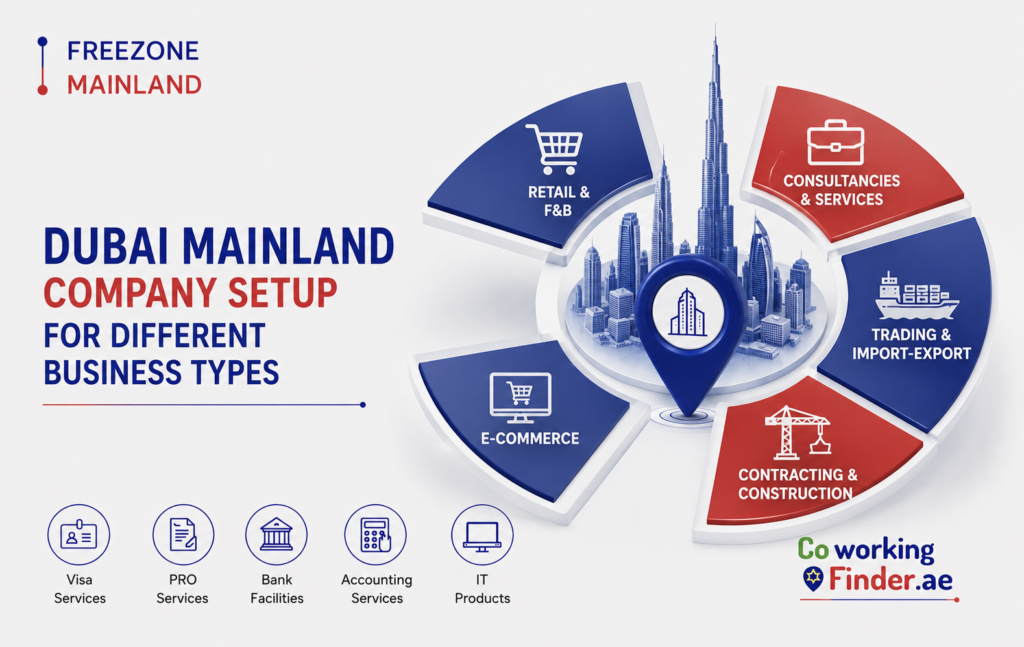
Dubai Mainland Company Setup for Different Business Types
The right structure for a Dubai mainland company setup depends heavily on the sector, and a few examples illustrate why.
- Retail and F&B businesses almost always need a mainland license, since shopfronts, restaurants, and cafes must be located in approved commercial zones and serve walk-in customers directly.
- Consultancies and professional services can operate from a free zone if all clients are outside the UAE, but any consultancy pitching UAE government or private-sector clients directly usually finds a Dubai mainland company setup pays for itself.
- Trading and import-export companies benefit from mainland status because it allows direct distribution to UAE retailers and wholesalers without routing sales through a local distributor.
- Contracting and construction firms are effectively required to hold a mainland license, since most government and large private infrastructure tenders are restricted to DET-licensed contractors.
- E-commerce businesses selling physical goods within the UAE increasingly choose a Dubai mainland company setup as well, since it simplifies logistics, customs clearance, and last-mile delivery registration.
Frequently Asked Questions
Can a foreigner fully own a mainland company in Dubai?
Yes. Following reforms to the Commercial Companies Law, most business activities now allow 100% foreign ownership for a Dubai mainland company setup, with a short list of strategic sectors still requiring Emirati participation.
Do I need a physical office for a mainland license?
Yes. A registered Ejari tenancy contract is mandatory for every Dubai mainland company setup, whether that is a private office, a serviced office, or an approved flexi-desk inside a licensed coworking space.
How much does a Dubai mainland company setup cost?
Most single-activity setups fall between AED 25,000 and AED 50,000 in the first year, including government fees, office rent, and a couple of employee visas, though multi-activity licenses and larger offices push costs higher.
Can a mainland company sponsor employee visas?
Yes. Visa quota is tied to your office size, so choosing the right workspace early affects how many staff you can sponsor as the business grows.
Is a mainland license better than a free zone license?
Neither is universally better; a Dubai mainland company setup suits businesses that need to trade directly across the UAE and bid for government contracts, while free zones suit export-focused or purely online businesses.
How long does the whole process take?
Most straightforward mainland company setups in Dubai are completed within seven to fifteen working days, though activities needing extra external approvals can take three to six weeks.
Can I use a coworking space to meet the Ejari requirement?
Yes, provided the coworking operator is authorized to issue Ejari-compliant tenancy contracts for licensing purposes; not all flexi-desk packages qualify, so confirm this before signing.
Do I need to register for corporate tax after my mainland company setup?
Yes. Every Dubai mainland company setup must register with the Federal Tax Authority for corporate tax regardless of current profit levels, even though profits under AED 375,000 are taxed at 0%.
How often does a mainland license need to be renewed?
Annually. Renewal requires an updated Ejari tenancy contract and settlement of government fees, so it is worth starting the renewal process around 60 days before the license expiry date.
Conclusion
In summary, a Dubai mainland company setup remains the most flexible route into the UAE market for businesses that need unrestricted local trading rights, access to government contracts, and room to scale visas as the team grows. The process is straightforward once you understand the sequence: choose the right activity, reserve a name, secure a compliant office with Ejari, and submit your file to DET. Getting the office decision right early, whether that means a private office, a serviced suite, or a licensed coworking flexi-desk, saves both time and money later in the process. Compare verified, Ejari-eligible workspace options on CoworkingFinder.ae to find an office that fits your budget and supports your Dubai mainland company setup from day one, and start your Dubai mainland company setup with confidence.
