

Office Space for UAE Mainland Trade License: Ejari & Tenancy Requirements Explained
If you are setting up a mainland company in the UAE, understanding Ejari for trade license approval is one of the most important pieces of the entire process. Every mainland trade license must be linked to a registered physical address, and that address has to be proven through a valid Ejari tenancy contract before the Department of Economy and Tourism will issue or renew your license. The good news is that once you understand exactly what qualifies, how the registration works, and what it costs, the whole process becomes refreshingly straightforward.
This guide walks through everything a founder needs to know about Ejari for trade license issuance, from the different types of qualifying office space to the step-by-step registration process, typical costs, and the most common mistakes to avoid. Whether you are launching your first mainland company or renewing an existing one, this guide will help you move through the requirement quickly and confidently.
Table of Contents
Why Office Space and Ejari Matter for Mainland Licensing
A mainland trade license authorizes your company to operate broadly across Dubai and, depending on your activity, across the wider UAE. In exchange for that flexibility, the Department of Economy and Tourism requires every mainland company to demonstrate a genuine physical presence, and Ejari is the official mechanism that proves it. Ejari registration is not a formality to skip past; it is a legally binding registration, managed by the Dubai Land Department, that ties your lease agreement directly to your company’s licensing record.
This requirement exists to protect everyone involved. It gives the government a verified address for inspections and correspondence, it gives landlords and tenants a legally recognized contract they can rely on in the event of a dispute, and it gives your business a clean paper trail that supports everything from utility connections to visa processing down the line. Far from being a burden, a properly registered Ejari is genuinely good for your business, since it unlocks DEWA connections, supports employee visa applications, and gives your company a verifiable presence that builds trust with banks and partners.
Quick Answer: Ejari and Tenancy Requirements at a Glance
If you only have a moment, here is the essential picture. Every mainland trade license needs a registered Ejari tenancy contract in the company’s exact legal name, matching the license before issuance or renewal. The lease must be registered within 30 days of signing, and it must remain valid for at least six months beyond your license renewal date. Qualifying office space ranges from a dedicated private office to a flexi-desk or smart office package offered by an approved business centre, and costs for the tenancy itself typically start from around AED 8,000 to AED 15,000 per year for flexible options, rising considerably for larger dedicated spaces.
| Requirement | What It Means | Typical Timeline |
| Ejari registration | Lease registered with Dubai Land Department | Within 30 days of signing |
| Name match | Ejari must match the company’s legal trade name | Before license issuance |
| Minimum validity | Ejari must be valid well beyond license renewal date | At least 6 months ahead |
| Qualifying space | Office, flexi-desk, smart office, warehouse, or shop | Depends on business activity |
| Approximate annual cost | Flexi-desk to dedicated office | AED 8,000 – 15,000+ |
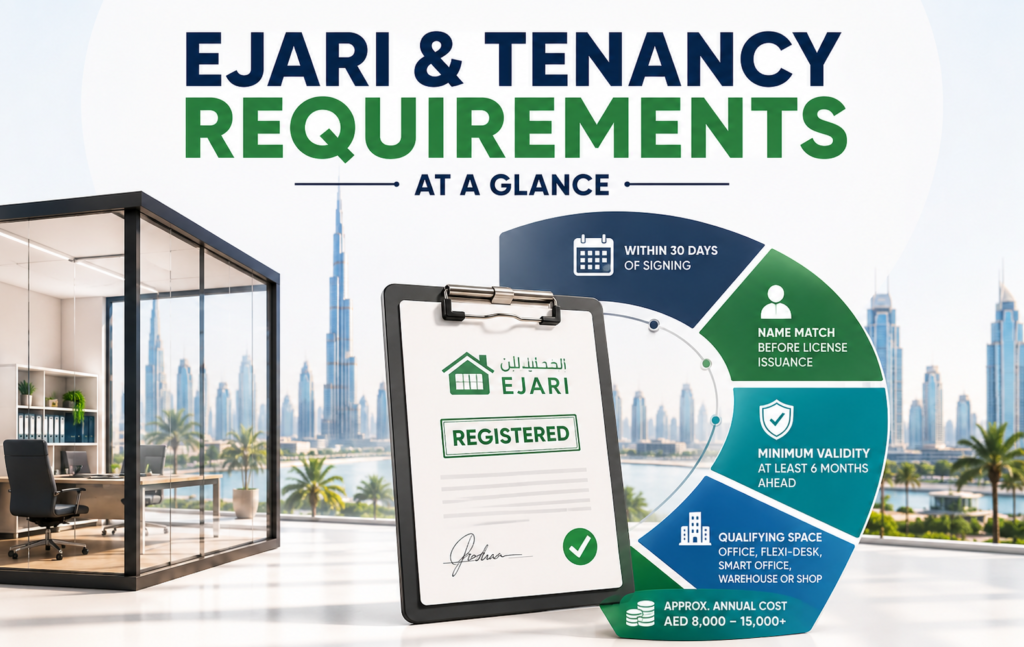
These figures give you a realistic starting point, but the exact Ejari for trade license requirements you will face depend on your business activity, your chosen jurisdiction, and the type of premises you select. Let’s look at each piece in detail.
What Is Ejari, and How Does It Work?
Ejari, which means “my rent” in Arabic, is the electronic registration system operated by the Dubai Land Department to formally record tenancy contracts across the emirate. Every commercial and residential lease in Dubai is expected to be registered through Ejari, and for mainland businesses this registration becomes the backbone of your trade license application. Once your landlord or authorized business centre registers the lease, the system issues an Ejari certificate that the Department of Economy and Tourism can verify directly during license issuance and renewal.
The Ejari for trade license process works by cross-referencing your company’s legal name, the registered premises, and the lease term against your license application. If the names do not match exactly, or if the registered address does not correspond to a genuine, accessible commercial space, the application will stall until the discrepancy is corrected. This is why getting the details right from the very beginning saves considerable time and back-and-forth later in the process.
Step by Step: From Lease Signing to License Approval
Understanding the sequence removes most of the uncertainty around Ejari registration applications, and most founders can move through it in a matter of days once they know what to expect.
First, you choose your business activity and confirm whether your license will be mainland or free zone, since only mainland licenses require this specific Ejari process. Second, you select a qualifying premises, whether that is a dedicated office, a flexi-desk package with an approved provider, or a larger commercial unit suited to your activity. Third, you sign a tenancy contract in your company’s exact legal name, taking care that spelling and structure match what will appear on your trade license. Fourth, the lease is registered through Ejari, either by the landlord directly or through an approved typing centre or business centre, generating your official Ejari certificate. Fifth, you submit this certificate alongside your other license documents to the Department of Economy and Tourism, which cross-checks the registration before granting approval. Finally, once your license is active, your Ejari continues to serve as your official address of record for DEWA connections, visa applications, and any future renewals, so keeping it valid and current is an ongoing part of running your business smoothly.
Most applicants find the entire sequence, from selecting a premises to holding an active, Ejari-backed trade license, takes anywhere from a few days to about two weeks, depending on how quickly documentation is prepared.
Types of Qualifying Office Space for Mainland Licenses
Not every kind of workspace satisfies the Ejari for trade license requirement in the same way, so it helps to understand your options before you commit to a lease.
| Space Type | Best Suited For | Notes |
| Dedicated Private Office | Established teams, client-facing businesses | Full Ejari in your company name, exclusive use |
| Flexi-Desk / Smart Office | Startups, consultants, small teams | Shared address through an approved business centre |
| Warehouse | Trading, logistics, light manufacturing | Requires activity-specific approvals |
| Retail Shop | Retail and F&B businesses | Location and frontage rules may apply |
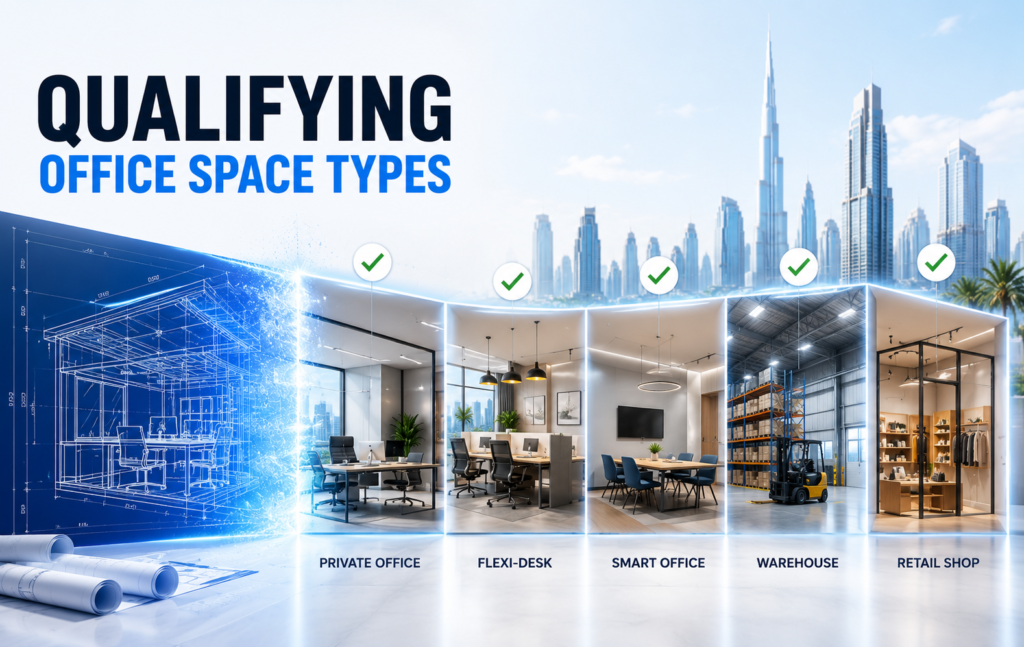
Dedicated private offices remain the most straightforward path, since the Ejari is issued directly in your company’s name for an exclusive space, with no shared elements to explain during inspections. Flexi-desk and smart office packages, offered through approved coworking and business centre providers, have become an extremely popular route for startups and small teams, since they satisfy the Ejari for trade license requirement at a fraction of the cost of a dedicated lease, while still providing a fully compliant, government-recognized address. Warehouses and retail shops follow the same Ejari registration principle but often require additional activity-specific approvals from municipal or sector authorities before the tenancy is accepted.
Tenancy Contract Requirements You Need to Get Right
A handful of details make the difference between a smooth Ejari approval and a frustrating back-and-forth with the authorities. The tenant name on the lease must match your company’s exact legal name as it will appear on the trade license, including correct spelling and legal suffixes. The lease term should comfortably cover your license period, with most experienced providers recommending at least six months of remaining validity at the point of any license renewal to avoid last-minute gaps. The registered address must correspond to a genuine, accessible commercial unit, since inspection visits and courier deliveries are sometimes used to verify that a business genuinely operates from its stated premises. Finally, the landlord or business centre must be authorized to register through Ejari, which is standard for licensed developments and approved business centres but worth confirming with newer or independent landlords.
How Ejari Registration Actually Happens
Once your tenancy contract is signed, registration itself is a relatively quick administrative step. For a dedicated office leased directly from a landlord, the landlord or their representative typically submits the signed contract, a copy of the title deed, and your trade license or initial approval documents through the Ejari system or an authorized typing centre, and a certificate is issued within a day or two. For flexi-desk and smart office packages, the business centre provider usually handles this registration entirely on your behalf as part of the package, meaning you receive a ready-to-use Ejari certificate without needing to navigate the system yourself. Either way, the resulting certificate carries an official Ejari number that the Department of Economy and Tourism verifies electronically, so there is no need to submit paper copies separately once the registration is complete.
Keeping Your Ejari Valid Through Renewal
Ejari for trade license compliance does not end once your license is first issued; it needs to stay current for as long as your company operates. Because trade licenses renew annually, your Ejari certificate needs to remain valid well beyond each renewal date, and many providers strongly recommend renewing your tenancy contract at least a month or two before it lapses to avoid any gap that could delay your license renewal. If you are using a flexi-desk or smart office package, most providers handle the Ejari renewal automatically alongside your annual package fee, which removes one more administrative task from your plate. If you lease a dedicated office directly, it is worth setting a calendar reminder well ahead of the expiry date, since a lapsed Ejari can hold up not just your license renewal but also visa processing and DEWA continuity.
Costs Involved in Office Space and Ejari Registration
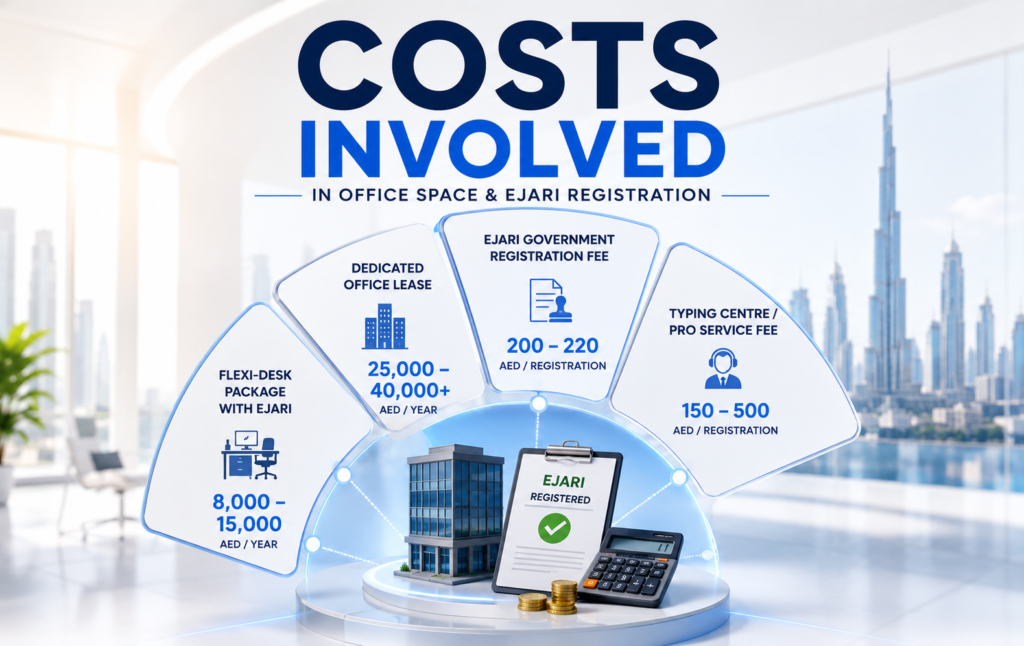
Budgeting accurately for Ejari for trade license compliance means accounting for a few distinct cost components rather than a single fee. A flexi-desk or smart office package that bundles Ejari registration typically costs between AED 8,000 and AED 15,000 per year, depending on the provider and jurisdiction. A dedicated private office lease can range considerably higher, often starting around AED 25,000 to AED 40,000 annually for a modest unit in a central district, and climbing well beyond that for larger commercial spaces. Ejari registration itself carries a modest government fee, generally in the range of AED 200 to AED 220, along with a small knowledge and innovation fee applied to most Dubai Land Department transactions. If you use a typing centre or PRO service to manage the registration on your behalf, expect a service charge of roughly AED 150 to AED 500 depending on the provider.
| Cost Component | Typical Range (AED) | Frequency |
| Flexi-desk package with Ejari | 8,000 – 15,000 | Annual |
| Dedicated office lease | 25,000 – 40,000+ | Annual |
| Ejari government registration fee | 200 – 220 | Per registration |
| Typing centre / PRO service fee | 150 – 500 | Per registration |
None of these costs are hidden by reputable providers, and asking for a complete, itemized quote before signing is the simplest way to understand your true first-year investment.
Why Flexi-Desk and Smart Office Options Are Worth Considering
For many startups, consultants, and small teams, a flexi-desk or smart office package is genuinely the most efficient way to satisfy the Ejari registration requirement. These packages are specifically designed by approved business centres and coworking providers to meet DET compliance standards while keeping costs low and paperwork minimal. Rather than negotiating a lease directly with a landlord, arranging your own Ejari registration, and furnishing an office from scratch, you receive a fully compliant, ready-to-use address along with your Ejari certificate as part of a single, predictable package. Many providers also include meeting room access, mail handling, and a straightforward upgrade path to a larger dedicated office once your business grows, which means you are never locked into a space that no longer fits your needs.
Common Mistakes to Avoid
A handful of avoidable errors account for most of the delays founders experience with Ejari for trade license applications. Signing a lease under a personal name rather than the company’s exact legal name is one of the most frequent issues, since the mismatch forces a correction before the license can be approved. Leaving Ejari renewal until the last minute is another common pitfall, since a lapsed certificate can quietly stall a license renewal that would otherwise have been straightforward. Choosing a premises without confirming the landlord or provider is authorized to register through Ejari can also cause unexpected delays, particularly with smaller or independent landlords unfamiliar with commercial registrations. Finally, underestimating the space requirements for certain activities, such as trading or manufacturing licenses that require warehouse or production facilities, can result in a rejected application if the registered premises does not match the declared business activity.
Avoiding these pitfalls is largely a matter of double-checking details early: confirm your company’s exact legal name before signing anything, choose a provider experienced with mainland compliance, and build in a comfortable buffer before every renewal deadline.
Who Should Consider Which Option?
Matching your premises choice to your business stage makes the entire Ejari for trade license process considerably smoother. Solo founders and small consulting teams are usually best served by a flexi-desk or smart office package, which delivers full compliance at the lowest cost and with the least administrative overhead. Growing teams that need daily desk space for multiple employees typically benefit from a dedicated office, since the exclusive use and larger footprint support a bigger headcount comfortably. Trading, logistics, and light manufacturing businesses will generally need a warehouse or production facility that satisfies both Ejari registration and any activity-specific approvals required by municipal authorities. Retail and food and beverage businesses should factor in location, frontage, and any special zoning rules on top of the standard Ejari registration process.
Ejari and Free Zone vs Mainland: Why the Requirement Differs
It helps to understand why this requirement exists specifically for mainland companies and not, in most cases, for free zone entities. A mainland license, issued by the Department of Economy and Tourism, allows a business to trade broadly across Dubai and often the wider UAE, which is precisely why the government requires verifiable proof of a genuine local premises through Ejari registration. Free zones, by contrast, operate under their own independent regulatory frameworks, and many offer their own flexi-desk or smart-desk facility agreements that serve a similar verification purpose without routing through the Dubai Land Department’s Ejari system directly. This distinction is not a loophole; it simply reflects the different governing authorities behind each licensing route, and it is one of the genuine advantages free zones offer to founders who want a slightly lighter administrative footprint in their first year.
For businesses that plan to work primarily online, serve clients outside the UAE, or operate within a single free zone’s permitted activities, this difference can meaningfully influence which jurisdiction makes the most sense. For businesses that need to trade freely across Dubai, work directly with government entities, or maintain a highly visible commercial presence, the mainland route, and its accompanying Ejari registration, generally remains the better long-term fit despite the additional paperwork.
Working With PRO Services and Business Setup Consultants
Many founders, particularly those setting up a company for the first time or managing the process from overseas, choose to work with a PRO service or business setup consultant to handle Ejari registration and the surrounding paperwork. A good consultant will confirm your company’s exact legal name before any lease is signed, coordinate directly with your landlord or business centre to ensure the registration is filed correctly, and track renewal deadlines so nothing lapses unexpectedly. This kind of support typically costs a modest service fee on top of the government charges, but it can save considerable time and prevent the kind of name-mismatch or documentation errors that commonly delay license approval. Even founders who are comfortable managing most of their own paperwork often find that outsourcing just the Ejari coordination step, especially during the initial setup phase, is a worthwhile investment given how central this single document is to the entire licensing process.
Preparing Your Documents in Advance
A little preparation before you approach a landlord or business centre provider can shave real time off the entire timeline. Most providers will ask for a copy of your trade name reservation or initial approval certificate, a passport copy for the company’s authorized signatory, and a clear description of your intended business activity so the premises can be matched appropriately to your licensing needs. If you are working with a business centre offering a flexi-desk or smart office package, many of these details can be handled as part of a single onboarding conversation, since the provider already understands exactly what the Department of Economy and Tourism expects from a compliant Ejari registration. Having your documents ready before your first meeting with a provider or landlord is one of the simplest ways to keep the whole process moving quickly and smoothly.
Frequently Asked Questions About Ejari for Trade License
Is Ejari mandatory for every mainland trade license in Dubai?
Yes. A valid, registered Ejari tenancy contract is a mandatory requirement for issuing or renewing almost every mainland trade license through the Department of Economy and Tourism.
Can I use a flexi-desk instead of a dedicated office for Ejari registration?
Yes. Many approved business centres and coworking providers offer flexi-desk and smart office packages that include a fully compliant Ejari certificate, making them a popular, lower-cost option for startups and small teams.
How long does Ejari registration take?
Once your tenancy contract is signed, Ejari registration typically takes one to two days when handled by an authorized landlord, business centre, or typing centre.
What happens if my Ejari expires before my license renewal?
A lapsed Ejari can delay your trade license renewal, so most providers recommend renewing your tenancy contract at least one to two months before it expires to avoid any gap in coverage.
Does the tenant name on the Ejari need to match my company name exactly?
Yes. The Ejari must be registered under your company’s exact legal name as it appears on your trade license, and any mismatch will need to be corrected before approval.
How much does Ejari registration cost?
The government registration fee is generally around AED 200 to AED 220, though typing centres and PRO services may charge an additional AED 150 to AED 500 for handling the registration on your behalf.
Do free zone companies also need Ejari?
Generally no. Ejari is specifically a mainland requirement tied to the Department of Economy and Tourism, though many free zones have their own equivalent tenancy or facility registration processes.
Conclusion: Getting Your Office Space and Ejari Right From the Start
Understanding Ejari for trade license requirements from the outset saves considerable time, cost, and stress as you build your mainland company in the UAE. Whether you choose a dedicated private office, a flexi-desk package, or a larger commercial unit suited to trading or manufacturing, the underlying principle stays the same: a genuine, registered tenancy that matches your company’s legal name and remains valid well beyond each renewal date. By choosing a reputable provider, confirming the details early, and building in a comfortable buffer before every renewal deadline, you can treat this requirement as a smooth, routine part of running your business rather than a recurring source of stress.
Dubai’s mainland licensing system continues to reward founders who prepare their paperwork carefully and choose the right premises for their stage of growth. With a clear understanding of what qualifies, how registration works, and what it costs, you are well equipped to move through the Ejari for trade license process confidently and keep your company compliant, credible, and ready to grow.
The Bigger Picture: Ejari as a Foundation for Growth
It is worth stepping back and recognizing that a well-chosen premises and a properly registered Ejari do more than satisfy a single licensing checkbox. They form the address that appears on your invoices, the location your bank associates with your company, and the base from which every future visa, renewal, and inspection is verified. Founders who treat this step with the same care they give to their business plan or their branding tend to encounter far fewer administrative surprises down the line. A flexi-desk or smart office package chosen thoughtfully in year one can carry your company smoothly through its first several renewal cycles, while still leaving room to upgrade to a larger dedicated space exactly when your team and client base are ready for it. Approached this way, Ejari registration stops feeling like a bureaucratic hurdle and becomes what it was always designed to be: a straightforward, protective foundation for a growing UAE business.
