Coworking for Startups UAE: A Practical Guide to Cost, Runway & Smart Growth Decisions (2026)
If you are building a startup in the UAE, one of the most consequential decisions you will make in your first year is not your product roadmap, your pricing model, or even your hiring plan. It is where your team works. Coworking for startups UAE has shifted from a cost-cutting tactic to a genuine strategic lever — one that directly influences how long your company survives, how fast it grows, and how intelligently it deploys capital.
This guide breaks down everything founders need to know about coworking for startups UAE in 2026: the real financial math, the growth-stage framework, the risks of getting it wrong, and how to make a workspace decision that actually serves your business.
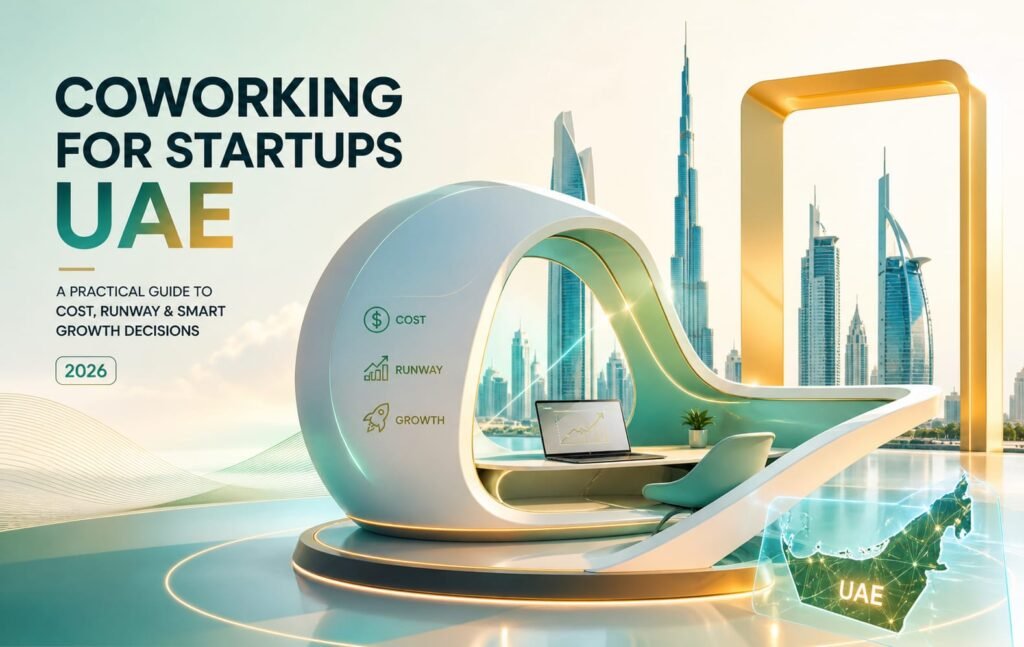
Table of Contents
Why Workspace Strategy Is a Startup Problem, Not an Office Problem
Most first-time founders approach office selection the wrong way. They think about it as a logistics question — how much space do we need, where is it located, what does it cost per month? But for early-stage companies, workspace is a financial strategy decision that ripples across your entire operation.
Coworking for startups UAE solves a specific and urgent problem: how do you build and scale a company without locking yourself into fixed costs that become impossible to reverse? In the early stages, revenue is unpredictable, team size keeps changing, and strategic priorities shift rapidly. Locking into a three-year office lease in that environment does not signal ambition — it signals a lack of financial discipline.
The right workspace is not about saving money alone. It is about protecting runway, maintaining flexibility, and keeping all growth options open.
The UAE Startup Ecosystem in 2026: Why This Conversation Matters Now
The UAE, particularly Dubai and Abu Dhabi, has become one of the most dynamic startup environments in the region. Government-backed programs, streamlined business licensing, and a rapidly maturing venture ecosystem have created conditions where entrepreneurship can genuinely thrive. Thousands of startups across fintech, healthtech, e-commerce, logistics, and deep tech are now operating out of the UAE, many of them scaling internationally from their first day.
Against this backdrop, coworking for startups UAE has evolved significantly. What was once seen as a fallback for companies that could not afford real offices is now recognized as the standard starting infrastructure for serious, capital-efficient founders. The question today is not whether to use a coworking space — it is which type, at which stage, and for how long.
The most successful startups in the UAE treat their workspace strategy the same way they treat their financial runway: as something to be protected, optimized, and scaled at the right moment — not before.
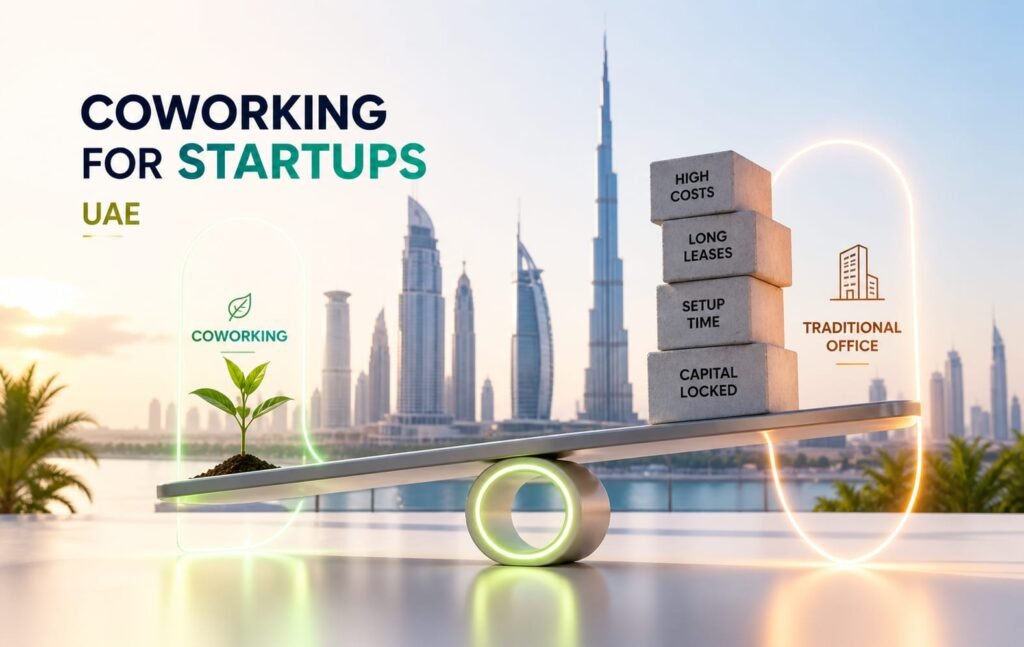
The Real Financial Difference: Coworking vs Traditional Office
The financial case for coworking for startups UAE becomes very clear when you model it against the alternative. Consider what a traditional office actually costs a startup in its first year.
| Cost Factor | Traditional Office | Coworking Space |
| Initial Setup Cost | AED 40,000 – 100,000 | AED 0 |
| Monthly Rent | AED 5,000 – 15,000 | AED 2,000 – 8,000 |
| Security Deposit | 2–3 months upfront | None or minimal |
| Furniture & Fit-out | AED 20,000 – 50,000 | Included |
| Flexibility | Low (12–36 month leases) | High (month-to-month) |
| Setup Time | 4–8 weeks | Same day |
Now apply this to a real startup budget. Suppose a founding team has AED 150,000 in early capital — a common scenario for bootstrapped or pre-seed UAE startups. Here is what happens to that capital depending on the workspace choice made in month one.
| Expense Category | Traditional Office | Coworking Space |
| Setup & Fit-out | AED 50,000 | AED 0 |
| First 6 Months Rent | AED 45,000 | AED 24,000 |
| Remaining Working Capital | AED 55,000 | AED 126,000 |
That difference — AED 71,000 — is not small. It is months of additional runway. It is the difference between surviving to your next milestone or not. Coworking for startups UAE preserves working capital where it actually creates value: product development, marketing, early hires, and customer acquisition.
Stage-by-Stage: Matching Your Workspace to Your Growth
One of the most underappreciated advantages of coworking for startups UAE is how naturally it maps to the different phases of early-stage growth. A workspace that works perfectly at the idea stage will actively hold you back during scaling — and vice versa. Founders who understand this make smarter decisions about when to upgrade, not just whether to.
| Startup Stage | Business Reality | Ideal Workspace |
| Idea Stage | No revenue, concept testing | Home / Virtual Office / Hot Desk |
| Validation Stage | Early users, product iteration | Flexible coworking membership |
| Early Growth | First revenue, hiring begins | Dedicated desks or small suite |
| Scaling Stage | Team expansion, process building | Private office within coworking |
| Established Growth | 20+ team members, stable ops | Dedicated office space |
The beauty of coworking for startups UAE is that it lets you move across these stages without disruption. You are not locked into a configuration that no longer fits. You can add desks as you hire, upgrade to a private suite when you need confidentiality, and eventually transition to a standalone office when your headcount and operational needs justify it.
Workspace should evolve with your business — not be decided once and forgotten. The right coworking setup grows with you.
Risk Analysis: What Founders Are Really Comparing
When founders evaluate workspace options, they often focus on the monthly cost. But the more important analysis is risk exposure. Coworking for startups UAE dramatically reduces the categories of risk that kill early-stage companies.
| Risk Type | Traditional Office | Coworking Space |
| Lock-in Risk | High — multi-year leases | None — monthly flexibility |
| Scaling Risk | High — fixed capacity | Low — scale up or down easily |
| Cash Flow Pressure | High — large fixed monthly cost | Low — predictable, manageable |
| Pivot Penalty | Severe — exit costs are significant | Minimal — adjust as needed |
| Downtime Risk | High — you manage everything | Low — fully managed environment |
Long-term leases do not just cost money — they reduce decision-making freedom. If your business model pivots, if a key hire falls through, or if you hit an unexpected cash crunch, a fixed office lease becomes a liability you cannot exit without significant cost. Coworking for startups UAE converts that fixed risk into a variable, manageable cost that moves with your business reality.
Productivity and Team Performance in Coworking Environments
A common concern among founders evaluating coworking for startups UAE is whether shared environments undermine team focus and productivity. The data and lived experience of UAE startup founders tells a different story.
| Work Setup | Productivity Level | Team Communication |
| Fully Remote | Variable / Medium | Often fragmented |
| Coworking Space | High | Strong — daily in-person |
| Traditional Office | High | Strong — daily in-person |
Remote-first teams save money, but they often pay the price in coordination overhead, cultural fragility, and slower decision-making. A well-chosen coworking environment gives early teams the structured, professional atmosphere that drives performance — without the financial exposure of a private office.
Most UAE coworking spaces designed for startups now offer private meeting rooms, sound-controlled phone booths, high-speed internet redundancy, and dedicated team zones. The infrastructure gap between coworking and a traditional office has largely closed for small and mid-sized startup teams.
The Ecosystem Advantage: Network Effects You Cannot Buy
There is a dimension of coworking for startups UAE that founders often overlook when running their financial models: the value of proximity to other builders, investors, and service providers.

The leading coworking spaces in Dubai and Abu Dhabi are not just buildings with desks. They are curated ecosystems where introductions happen over coffee, partnerships form in shared kitchens, and investor connections are made through community events. These are the kinds of interactions that money cannot directly buy — they emerge from being in the right environment.
For a startup trying to close its first enterprise deal, find a technical co-founder, or identify a reliable legal advisor in the UAE, being embedded in a strong coworking community can accelerate timelines by months. This is a real, measurable advantage of coworking for startups UAE that rarely appears in cost-benefit spreadsheets.
- Access to other founders working through similar challenges
- Informal introductions to angels, VCs, and accelerator managers
- Proximity to legal, financial, and marketing service providers
- Community events, pitch nights, and knowledge-sharing sessions
- Referrals and collaboration opportunities across adjacent industries
When Coworking Is Not the Right Answer
Intellectual honesty is important here. Coworking for startups UAE is not the optimal solution for every company at every stage. There are clear signals that indicate a startup has outgrown the coworking model and needs to transition.
The most obvious trigger is team size. When a startup’s headcount exceeds 15 to 20 people, the economics and logistics of coworking begin to work against you. At that scale, you are paying enough in monthly fees to justify a dedicated lease, and you likely need greater control over your environment — from hardware security to company culture.
Other scenarios where coworking for startups UAE becomes less suitable include businesses that handle sensitive data or require high levels of client confidentiality, companies that need significant physical infrastructure or specialist equipment, and teams that require deep cultural immersion and brand-specific environments that shared spaces cannot provide.
Common Mistakes UAE Startups Make with Workspace Decisions
Having observed how founders in the UAE approach workspace decisions, several patterns of avoidable error emerge consistently.
Committing to Office Space Too Early
The most common and costly mistake is locking into a traditional office before the business has demonstrated repeatable revenue. At that stage, the startup is paying for a perception of stability it has not yet earned.
Choosing for Prestige Rather Than Function
Some founders select a prestigious address or a sleek fit-out to signal credibility to investors or clients. In most cases, investors care about traction and team quality — not the postcode on your business card.
Ignoring Scalability in the Agreement
Signing into a coworking membership that does not allow you to grow your team or upgrade your setup without significant friction is a hidden trap. Always evaluate the flexibility terms, not just the monthly rate.
Underestimating the True Cost of Long Contracts
A lower monthly rate on a 24-month coworking contract is not always a better deal than a higher rate on a monthly rolling agreement. The cost of being locked in during a pivot or downturn can far exceed the discount.
A Decision Framework for Founders Evaluating Workspace Options
Before committing to any workspace decision, UAE founders should work through a straightforward set of questions that map directly to the considerations that matter most in the early stages.
| Question | Answer is YES → Consider | Answer is NO → Consider |
| Is our revenue still uncertain? | Coworking for flexibility | Evaluate private office |
| Does our team size change frequently? | Coworking for scalability | Longer-term setup |
| Is capital preservation critical right now? | Coworking to extend runway | Larger space investment |
| Do we need deep privacy or security? | Private suite or office | Open coworking works |
| Are we likely to pivot in the next 12 months? | Coworking to stay agile | Dedicated office is viable |
The Smart Growth Path: A Three-Phase Workspace Strategy
The most capital-efficient UAE startups follow a deliberate workspace progression rather than making one big decision and sticking with it indefinitely. Coworking for startups UAE works best when it is treated as Phase Two of a broader journey.
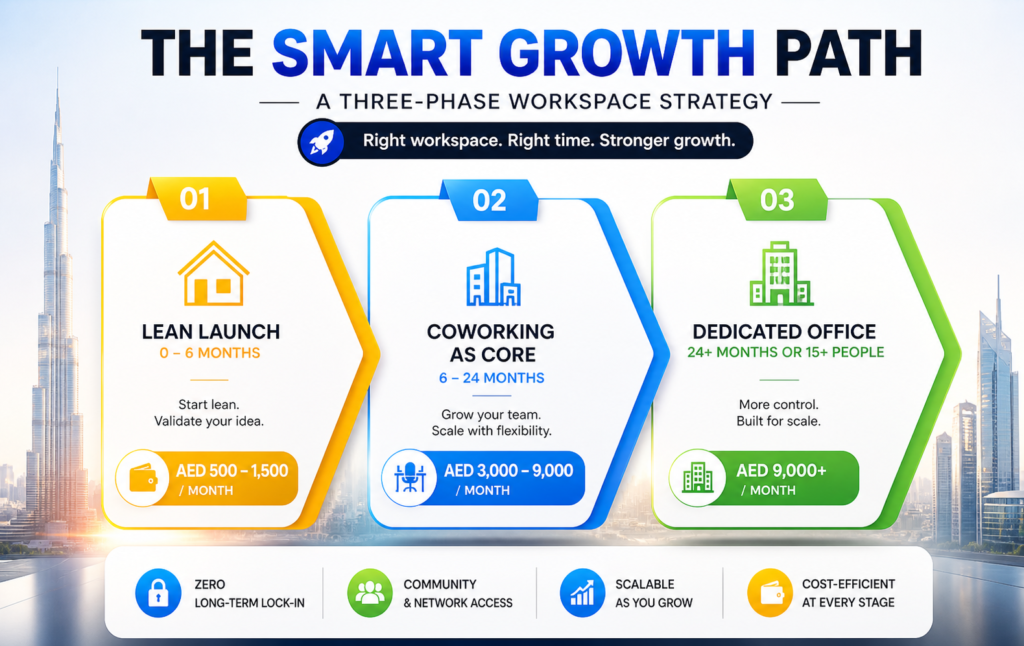
Phase One — Lean Launch (0 to 6 Months)
No dedicated office. Work from home, use virtual office addresses for licensing and mail, and book coworking day passes for meetings and focused work sprints. Total monthly workspace cost: AED 500 to 1,500. This phase is about validating the idea without incurring structure costs.
Phase Two — Coworking as Core Infrastructure (6 to 24 Months)
Once the team grows to three or more people and the product has early traction, commit to a proper coworking membership. Start with flexible desks, then upgrade to a dedicated team suite as hiring accelerates. Monthly workspace cost: AED 3,000 to 9,000. This is where coworking for startups UAE delivers maximum value — professional environment, community access, and zero long-term lock-in.
Phase Three — Dedicated Office (24+ Months or 15+ People)
When the team exceeds 15 people and operational needs require greater control, transition to a private office. By this stage, the startup should have revenue stability and a clear enough growth trajectory to justify a fixed lease. Monthly cost rises, but the business is now sized to absorb it.
Frequently Asked Questions: Coworking for Startups UAE
How much runway can coworking genuinely save a UAE startup?
In most cases, choosing coworking over a traditional office in the first year of operations can extend runway by three to six months. For a startup operating on AED 150,000 in initial capital, that difference can mean the distance between reaching product-market fit and running out of money before you get there.
Is coworking a credible workspace option for investor-backed startups?
Yes, and increasingly so. Many UAE startups that have raised pre-seed and seed rounds continue to operate from coworking spaces well into their growth phase. Investors today understand that capital efficiency is a discipline, not a limitation — and working from a coworking space signals financial maturity rather than resource poverty.
At what team size should a startup consider transitioning out of coworking?
The practical threshold is 15 to 20 people. Below that, the economic and operational advantages of coworking for startups UAE typically outweigh those of a private lease. Above that threshold, the costs begin to converge, and the need for greater operational control, cultural environment, and data security generally tips the balance toward a dedicated office.
What should I look for in a UAE coworking space as a startup founder?
Prioritize flexibility of membership terms above all else. After that, evaluate internet reliability, private meeting room availability, proximity to relevant networks (investors, mentors, industry peers), and the overall community quality. A well-connected coworking community in Dubai or Abu Dhabi can generate more value than the desk itself.
Does coworking work for remote-first or hybrid startup teams?
Yes, particularly for hybrid models. Many coworking spaces in the UAE offer flexible membership tiers that allow team members to book desks on the days they need them. This gives hybrid teams a professional anchor without paying for fully occupied permanent space, which is a strong cost-efficiency outcome.
Can coworking spaces in the UAE help startups scale faster?
Yes — primarily because they reduce operational friction. Instead of spending time on leases, fit-outs, utilities, and office administration, founders can focus on hiring, product development, and customer acquisition. That speed advantage often translates into faster execution during the most critical early-growth stages.
Are coworking spaces in the UAE suitable for startups in regulated industries?
They can be, provided the space offers adequate privacy and compliance-friendly infrastructure. Startups in fintech, legal tech, or health-related sectors should prioritize private offices, secure internet systems, and access controls to ensure confidentiality while still benefiting from coworking flexibility.
How does coworking compare to serviced offices for startups in the UAE?
Coworking is generally more cost-effective and community-driven, making it ideal for early-stage ventures. Serviced offices provide greater privacy and branding opportunities but at a higher monthly cost. For startups focused on lean growth, coworking often delivers the better balance of affordability and functionality.
Can coworking spaces support startup networking and partnerships?
Absolutely. One of the strongest advantages of coworking for startups UAE is exposure to other founders, investors, freelancers, and service providers within the same ecosystem. These informal connections can lead to partnerships, referrals, mentorship, and even funding opportunities over time.
Is coworking a long-term solution or only for early-stage startups?
While coworking is most valuable in the early stages, many startups continue using it well into their expansion phase. As long as the space supports team growth, operational needs, and business image, coworking can remain a practical long-term strategy rather than just a temporary setup.
Choose Workspace Strategy, Not Just Workspace
The decision around coworking for startups UAE is ultimately not a real estate question — it is a business strategy question. Every dirham tied up in an underutilized office is a dirham not invested in the things that actually build your company. Every month spent in a workspace that no longer fits your stage is a month of momentum lost.
The UAE’s startup ecosystem in 2026 rewards founders who stay lean, stay agile, and invest in growth over appearances. Coworking for startups UAE gives you the tools to do exactly that — a professional environment, a connected community, and the financial flexibility to move quickly when the market demands it.