

Coworking Space in Dubai: 10 Costly Mistakes Businesses Must Avoid in 2026
One Wrong Decision Can Cost You Thousands
Picture this: You sign a 12-month lease for a coworking space in Dubai Marina that looks stunning on the website. The interior is sleek, the Instagram reel is impressive, and the sales rep was charming. Three weeks later, the reality hits hard. The Wi-Fi drops every afternoon during your critical client calls. The meeting rooms are always booked. Your team cannot focus because the open-plan floor is essentially a nightclub at midday. You are locked in, the contract has no exit clause, and you are burning AED 8,000 a month on a space that is actively hurting your business.
This is not a fictional horror story. It happens to hundreds of businesses across Dubai every single year. With over 200 coworking spaces operating across the emirate, from Business Bay and DIFC to JLT and Dubai Silicon Oasis, the sheer number of choices creates a unique challenge: finding the workspace that truly aligns with your business needs, growth plans, and budget. While Dubai offers exceptional flexibility and variety, making the right decision requires careful evaluation and a clear understanding of what your business needs today and in the future.
Dubai’s coworking industry has exploded. According to industry estimates, the UAE flexible workspace market grew by over 30% between 2022 and 2025, fueled by post-pandemic hybrid work culture, an influx of international entrepreneurs, and a rapidly growing startup ecosystem. But growth brings noise, and noise brings bad decisions.
This guide exposes the 10 most costly mistakes businesses make when choosing a coworking space in Dubai, backed by real comparisons, insider insights, and actionable advice so you can make a decision you will be proud of twelve months from now.
Choosing the wrong coworking space in Dubai can lead to hidden costs, productivity challenges, and long-term business setbacks. Learn how to avoid the most common mistakes.
Table of Contents
Types of Coworking Memberships in Dubai
Before we dive into the mistakes, use this table to understand what your options actually look like across Dubai’s major coworking formats:
| Factor | Dedicated Desk | Hot Desk | Private Office | Virtual Office | Enterprise Suite |
| Monthly Cost (AED) | 1,800–2,500 | 900–1,400 | 5,000–15,000 | 300–800 | 20,000+ |
| Privacy Level | Medium | Low | High | None (remote) | Very High |
| Lease Flexibility | Monthly | Daily/Monthly | 3–12 months | Monthly | Annual+ |
| Mail & Address | Included | Not included | Included | Included | Included |
| Meeting Room Access | Discounted | Pay-per-use | Included hours | Pay-per-use | Dedicated rooms |
| Best For | Freelancers | Nomads | Small teams | Startups | Corporates |
| Free Trial Available | Often yes | Yes | Rarely | Sometimes | Rarely |
Now that you know the landscape, here are the 10 mistakes you absolutely must avoid.
Mistake 1: Choosing Location Based on Prestige, Not Practicality
Dubai is a city where your address carries social weight. DIFC sounds powerful. Downtown Dubai feels impressive. Dubai Marina looks glamorous. These are all valid observations. They are also completely irrelevant if your team spends two hours in traffic every day commuting to reach the office.
Many businesses, especially early-stage startups trying to impress investors and clients, prioritize a prestigious postcode over genuine accessibility. The result is a workforce that is chronically stressed, frequently late, and quietly resentful. Productivity crumbles long before the lease ends.
What You Should Do Instead
Map the commute routes for every member of your team before signing anything. Check proximity to the Dubai Metro, RTA bus stops, and major road connections. If your clients are predominantly in one part of the city, pick a space that is central to them, not central to your ego.
Areas like Jumeirah Lake Towers (JLT), Business Bay, and Al Quoz offer excellent infrastructure, competitive pricing, and strong transport links without the premium price tag of downtown addresses. A well-located office in JLT can save you 20 to 40 percent on monthly costs compared to a comparable DIFC address.

Pro Tip: Visit the space during peak commute hours (8:00 to 9:30 AM) before signing. What looks like a smooth journey on Google Maps at 2:00 PM can be a 45-minute nightmare at rush hour.
Mistake 2: Ignoring the True Cost of Hidden Fees
The headline price on a coworking website is rarely the price you end up paying. Dubai’s coworking market is particularly notorious for a pricing structure that appears competitive on the surface but conceals a range of additional charges that compound quickly.
Common hidden fees include: charges for using meeting rooms beyond a small monthly allocation, printing and scanning fees, guest pass charges, locker rental, parking passes, event space access, dedicated landline numbers, mail handling beyond a basic level, and IT support. Some spaces even charge for the use of their pantry services beyond basic coffee.
Real Example
A hot desk membership at AED 1,200 per month sounds reasonable. But add four half-day meeting room bookings at AED 250 each, two guest passes at AED 100 each, and a parking spot at AED 500 per month, and your actual bill is AED 2,700. You have more than doubled your base cost without using anything extraordinary.
Pro Tip: Request a full itemized breakdown of every possible charge before signing. Ask specifically: what is NOT included in this plan? A transparent provider will answer without hesitation.
Mistake 3: Underestimating the Impact of Internet Quality
In Dubai’s knowledge economy, internet connectivity is not a feature. It is the foundation. Yet an astonishing number of businesses sign coworking contracts without ever testing the actual internet performance during peak hours.
Many coworking spaces advertise high-speed fiber connections, but the reality depends enormously on how many simultaneous users share that bandwidth, how the network is managed, and whether dedicated business-grade support is available. A 1 Gbps line shared among 300 people at noon is not a 1 Gbps experience. It is closer to chaos.
What to Test Before You Sign
- Run a speed test (Speedtest.net or Fast.com) from the space during peak hours, ideally between 11:00 AM and 2:00 PM on a weekday
- Ask if the space offers dedicated VLAN or a private business network option
- Test video call stability for at least 30 minutes using Zoom or Microsoft Teams
- Inquire about the SLA (Service Level Agreement) for downtime and how quickly IT support responds
Pro Tip: Ask if the space provides a dedicated IP address. This is critical for businesses with VPN requirements, financial services compliance, or sensitive client data protocols.
Mistake 4: Failing to Assess Noise Levels and Work Culture Fit
Coworking spaces are diverse ecosystems. Some are intentionally designed as collaborative, buzzing, social environments where energy and noise are features, not bugs. Others maintain quiet zones and library-like focus areas. The problem arises when a business that requires deep concentration accidentally lands in a space built for extroverted networking.
This mismatch is one of the most underrated productivity killers in the Dubai coworking scene. Developers, writers, researchers, consultants, and finance professionals who require focused, uninterrupted blocks of work will suffer enormously in a loud, open-plan environment, regardless of how beautiful the space looks.
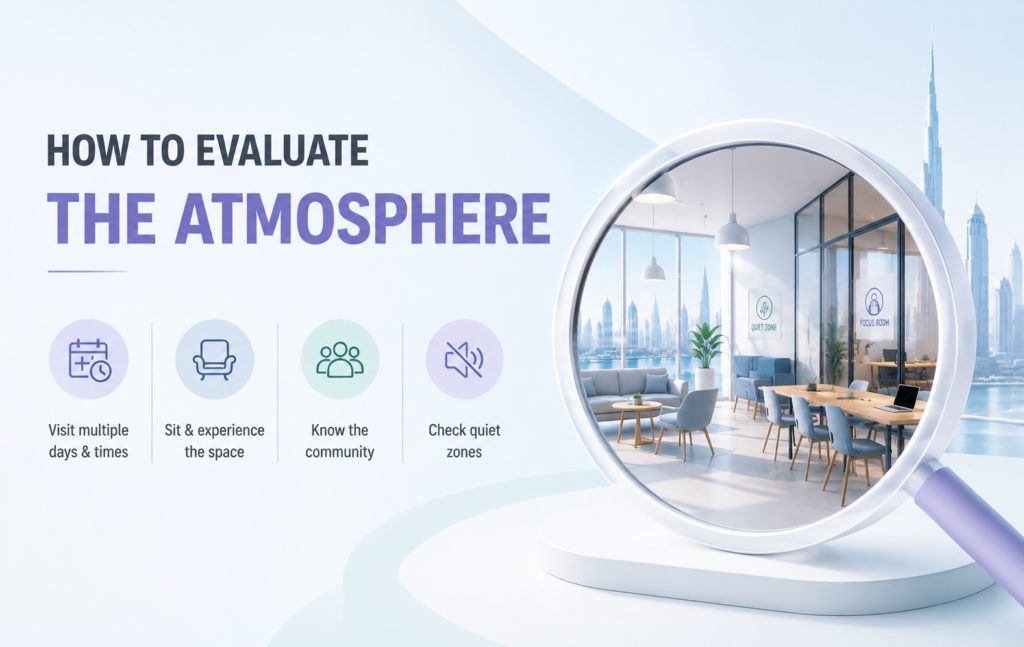
How to Evaluate the Atmosphere
- Visit the space on multiple days and at different times, including mornings and afternoons
- Sit in the area where your team would work for at least 30 minutes without headphones
- Ask the community manager what type of professionals and industries currently occupy the space
- Check if there are designated quiet zones or focus rooms and whether they are actually respected
Pro Tip: Look at the events calendar. A space that hosts weekly happy hours and daily networking sessions is a community-first space. If your team needs heads-down focus, this environment will frustrate them within weeks.
Mistake 5: Not Verifying the Legality and Free Zone Compliance
This is the mistake that can have the most serious legal and financial consequences for businesses in Dubai, and it is also one of the least discussed. Dubai has a complex regulatory landscape that distinguishes between mainland businesses and free zone entities, and not every coworking space is licensed to host both types.
If you operate under a Dubai mainland trade license, you may face restrictions working from a free zone coworking space and vice versa. Some businesses require a physical office address, not just a virtual one, to maintain their license validity. Others need their business address registered with the DED (Department of Economic Development) or a specific free zone authority, and using an unlicensed coworking space can result in license cancellation or fines.
Critical Checks to Make
- Confirm whether the coworking space can legally be registered as your business address with the DED or your relevant free zone authority
- Verify that the space holds the correct licensing to host businesses under your specific trade activity
- Understand the difference between a virtual office address for correspondence and a physical registered office address for licensing purposes
- Consult a UAE business setup consultant before assuming your coworking address satisfies all legal requirements
Pro Tip: Ask the coworking space directly: ‘Can I use this address for my DED trade license renewal?’ A reputable space will give you a clear, documented answer.
Mistake 6: Overlooking Scalability and Growth Plans
Businesses evolve. The team of three you are today may become the team of fifteen in eighteen months. One of the most painful experiences in Dubai’s business community is finding a perfect coworking space, growing successfully, and then realizing you have outgrown it but cannot leave because you are trapped in a long-term contract with no upgrade path.
Conversely, some businesses over-commit to large private offices during optimistic growth phases and find themselves paying for empty desks when plans change.
What to Look for in a Scalable Space
- Can you upgrade from a hot desk to a dedicated desk to a private office within the same provider, without penalty?
- Does the space have multiple locations in Dubai so you can expand or shift without switching providers?
- Are the contract terms flexible enough to accommodate team growth, ideally with rolling monthly options or transparent scale-up pricing?
- Does the space offer team day passes so you can temporarily expand capacity during project sprints or hiring phases?
Pro Tip: Ask for a written document showing how pricing scales as your team grows. Some providers reward loyalty with discounted upgrade paths, while others reset pricing entirely.
Mistake 7: Trusting Online Reviews Without Deeper Research
Google reviews and social media ratings are useful, but they are incomplete and often manipulated. A coworking space with 4.8 stars and 200 glowing reviews may have those reviews primarily from event attendees, day pass users, or people who visited during the initial honeymoon period of a new opening. The experience of a committed long-term member using the space 50 hours per week is entirely different.
Dubai’s coworking market, like most service industries in the city, is highly image-conscious. Spaces invest heavily in professional photography, influencer partnerships, and curated social media presence. The gap between how a space looks online and how it performs for actual working members can be substantial.
Better Ways to Verify Quality
- Ask the space to connect you directly with two or three current members who have been there for at least six months
- Check platforms like Trustpilot, LinkedIn reviews, and Reddit’s UAE expat communities for unfiltered feedback
- Ask specifically about what issues have arisen and how the management responded, since problem resolution tells you more than problem absence
- Request a full-day trial pass rather than a quick tour
Pro Tip: Pay attention to how the sales team treats you when you have a complaint or a difficult question during the viewing stage. Their behavior under mild pressure is a preview of how they will manage real problems.
Mistake 8: Neglecting the Community and Networking Potential
This mistake is the mirror image of Mistake Four. While some businesses need quiet focus, others actively depend on a vibrant professional community for growth, leads, partnerships, and visibility. Choosing a coworking space purely on functional metrics without evaluating its community quality is a missed opportunity at best and a strategic error at worst.
Dubai’s coworking scene has evolved beyond simple desk rental. The best spaces are functioning ecosystems where introductions happen over coffee, partnerships form during lunch, and referrals flow naturally through trusted networks. If business development, client acquisition, or ecosystem building matters to your company, the community inside your coworking space is a commercial asset.
Evaluating Community Quality
- What industries and business stages are most represented in the current member base?
- Does the space run curated member-to-member introduction programs or rely purely on organic interaction?
- Do members attend events willingly, or are events poorly attended despite free food and drinks?

Pro Tip: A coworking space that publicly showcases member success stories, partnerships formed inside the community, and collaborative projects is demonstrating genuine community value, not just marketing.
Mistake 9: Signing Long Contracts Without Exit Clauses
In the competitive Dubai coworking market, many operators push hard for annual contracts with attractive headline discounts. A 12-month commitment at a 15 percent discount sounds financially sensible until circumstances change and you realize you are legally bound to a space that no longer serves you.
Business circumstances in Dubai can shift rapidly. Economic cycles, team restructuring, client relocations, personal life changes, and even the simple discovery that a space is not a good fit are all legitimate reasons why businesses need flexibility. A rigid annual contract with no exit clause transforms from a saving into a liability with remarkable speed.
Contract Terms to Negotiate Before Signing
- A break clause that allows you to exit with 30 to 60 days written notice after an initial lock-in period of three to four months
- Clear definitions of what constitutes a material breach by the operator that would entitle you to early termination
- Explicit terms around deposit refund timelines, ideally within 14 to 21 working days of vacancy
- Force majeure clauses that protect you during unforeseen disruptions, especially relevant after the global events of recent years
Pro Tip: Never accept a contract that requires you to pay 100 percent of remaining months upon early termination. A maximum of two to three months penalty is standard and negotiable in most cases.
Mistake 10: Not Visiting the Space at Different Times of Day
The single most common and most preventable mistake on this list is making a decision based on a single scheduled tour. Coworking spaces are dynamic environments. The experience at 10:00 AM on a Tuesday when the community manager is guiding you through a rehearsed presentation is categorically different from the experience at 1:00 PM when the space is at full capacity, the kitchen is crowded, and the acoustic tiles are working overtime.
Humidity levels, temperature inconsistencies in air conditioning, cleaning schedules, delivery noise, construction work in neighboring units, and the sheer energy level of a packed floor are all things that only reveal themselves over multiple visits at varied times.
Your Multi-Visit Checklist
- Morning visit (8:30 AM to 10:00 AM): Assess the early arrival experience, parking availability, and opening efficiency
- Midday visit (12:00 PM to 2:00 PM): Experience full-capacity noise, kitchen and food area congestion, and peak hour internet performance
- Late afternoon visit (4:00 PM to 6:00 PM): Evaluate the wind-down atmosphere and whether it supports focused end-of-day work
- Ask to sit and work independently for a minimum of two hours without being hosted or managed
Pro Tip: Take note of how the cleaning and maintenance staff interact with the space. A well-maintained coworking space during peak hours reflects strong operational management.
10 Frequently Asked Questions About Coworking Spaces in Dubai
1. What is the average cost of a coworking space in Dubai in 2025?
The cost of a coworking space in Dubai varies depending on the location, facilities, and membership type. Hot desks typically range from AED 900 to AED 1,400 per month, while dedicated desks cost between AED 1,800 and AED 2,500. Private offices generally start from AED 5,000 per month and can exceed AED 15,000 in premium locations such as DIFC and Downtown Dubai. Businesses should also factor in additional costs such as parking, meeting room usage, and guest access.
2. Can a coworking space in Dubai be used for business licensing and company registration?
Yes, many coworking spaces in Dubai offer registered business address services that can be used for company formation and licensing purposes. However, eligibility depends on the coworking provider, the business activity, and whether the company is registered in a mainland jurisdiction or a free zone. Always verify with the workspace provider and the relevant licensing authority before proceeding.
3. Is a coworking space in Dubai suitable for startups and small businesses?
Absolutely. A coworking space in Dubai is one of the most cost-effective solutions for startups, freelancers, and SMEs. It eliminates the need for long-term leases, furniture investments, and office maintenance costs while providing access to professional facilities, networking opportunities, and flexible membership options that can scale with business growth.
4. What is the difference between a hot desk and a private coworking space in Dubai?
A hot desk allows members to use any available workstation within a shared environment and is ideal for freelancers or remote workers. A private office, on the other hand, provides an enclosed workspace exclusively for a team or company, offering greater privacy, security, and branding opportunities. Businesses handling sensitive information often prefer private offices over hot desks.
5. How do I choose the best coworking space in Dubai for my business?
When selecting a coworking space in Dubai, consider factors such as location, accessibility, internet reliability, meeting room availability, community quality, scalability, parking facilities, and licensing compatibility. It is also advisable to visit the space at different times of the day and request a trial period before committing to a contract.
6. Are meeting rooms included in a coworking space in Dubai membership?
Most coworking spaces in Dubai provide meeting room access, but the terms vary. Some memberships include a limited number of complimentary meeting room hours each month, while others charge separately based on usage. Businesses that regularly host clients or team meetings should carefully review meeting room policies and pricing structures before signing up.
7. Can international companies use a coworking space in Dubai as their regional headquarters?
Yes. Many international businesses use a coworking space in Dubai as a regional base for operations across the Middle East and North Africa. Premium coworking providers often offer private offices, business support services, PRO assistance, and flexible expansion options that make them attractive to foreign companies entering the UAE market.
8. Which locations offer the best coworking space in Dubai for entrepreneurs?
Popular coworking locations in Dubai include Business Bay, Jumeirah Lake Towers (JLT), DIFC, Dubai Marina, Dubai Internet City, and Dubai Silicon Oasis. The best location depends on your industry, client base, commuting requirements, and budget. Business Bay and JLT are often preferred due to their balance of accessibility, affordability, and business infrastructure.
9. Does a coworking space in Dubai provide visa assistance and business setup services?
Many premium coworking operators provide visa assistance, PRO services, Emirates ID support, company formation guidance, and business setup consultancy through licensed partners. These services are particularly useful for entrepreneurs and overseas businesses looking to establish a presence in Dubai quickly and efficiently.
10. What should I look for before signing a contract for a coworking space in Dubai?
Before signing a contract, review the lease terms carefully. Pay close attention to cancellation policies, notice periods, security deposits, hidden charges, internet service quality, business licensing eligibility, office access hours, parking availability, and future upgrade options. Choosing a flexible agreement can save significant costs if your business needs change.
Final Thoughts: Making the Right Decision in Dubai’s Competitive Market
Dubai’s coworking market is extraordinary in its diversity, ambition, and quality. From cutting-edge tech hubs to boutique creative studios, from enterprise-grade campuses to intimate community spaces, there is genuinely a perfect workspace for every business type, growth stage, and working style.
But the abundance of choice demands disciplined decision-making. The 10 mistakes outlined in this guide are not theoretical risks. They are documented, recurring patterns that cost Dubai businesses time, money, reputation, and momentum every single year.
The businesses that thrive in Dubai’s coworking ecosystem are those that treat the selection process with the same rigor they apply to hiring a senior employee or choosing a business partner. They visit multiple times, ask difficult questions, negotiate sensible terms, and prioritize practical fit over aesthetic appeal.
Your workspace is not just an address. In a city as dynamic and relationship-driven as Dubai, it is a statement about who you are, a platform for who you are becoming, and a daily environment that either energizes or drains the people who make your business work.
