

Company Formation UAE: The Complete 2026 Guide to Costs, Free Zones & Mainland Setup
Every year, tens of thousands of entrepreneurs choose company formation UAE as the starting point for their regional or global business. Zero personal income tax, 100% foreign ownership across almost every sector, and a location that sits between Europe, Asia, and Africa make the country one of the most searched-for business destinations in the world. But “setting up a company in the UAE” isn’t one process — it’s a decision tree, and the wrong turn can cost you months and thousands of dirhams in wasted fees.
This guide walks through everything involved in company formation UAE in 2026: how mainland, free zone, and offshore structures differ, what each one actually costs once you add visas and office space, the step-by-step licensing process, and how to compare specific free zones like SHAMS, Meydan Free Zone, IFZA, DIFC, and DMCC against each other. Whether you’re a solo consultant applying for a freelance permit or a founder planning to raise capital, you’ll find the practical detail that generic overviews skip.
This is also why so many first-time founders start their company formation UAE research overwhelmed: the free zone directory alone lists more than forty options, each with its own fee schedule, activity list, and visa allocation rules. The goal of this guide is to cut through that noise — not by naming a single “best” free zone, since none exists, but by giving you the cost benchmarks, process timeline, and jurisdiction comparisons needed to make a decision that fits your specific business rather than a generic template.
Table of Contents
Why Entrepreneurs Choose the UAE
Company formation UAE activity has grown steadily because the fundamentals rarely change: no personal income tax, a corporate tax regime that still allows 0% for qualifying free zone profits, fast-improving digital government services, and a stable currency pegged to the US dollar. Add to that world-class logistics — two of the busiest airports and container ports in the region — and it’s easy to see why founders from India, the UK, Europe, and across Africa treat UAE company formation as a genuine growth decision rather than just a tax-efficient address.
The market has also matured. A decade ago, most company formation UAE conversations began and ended with “which free zone is cheapest.” Today, with corporate tax in effect and stricter economic substance rules, the smarter question is which structure matches how and where you actually plan to sell.
The Three Structures: Mainland, Free Zone, and Offshore
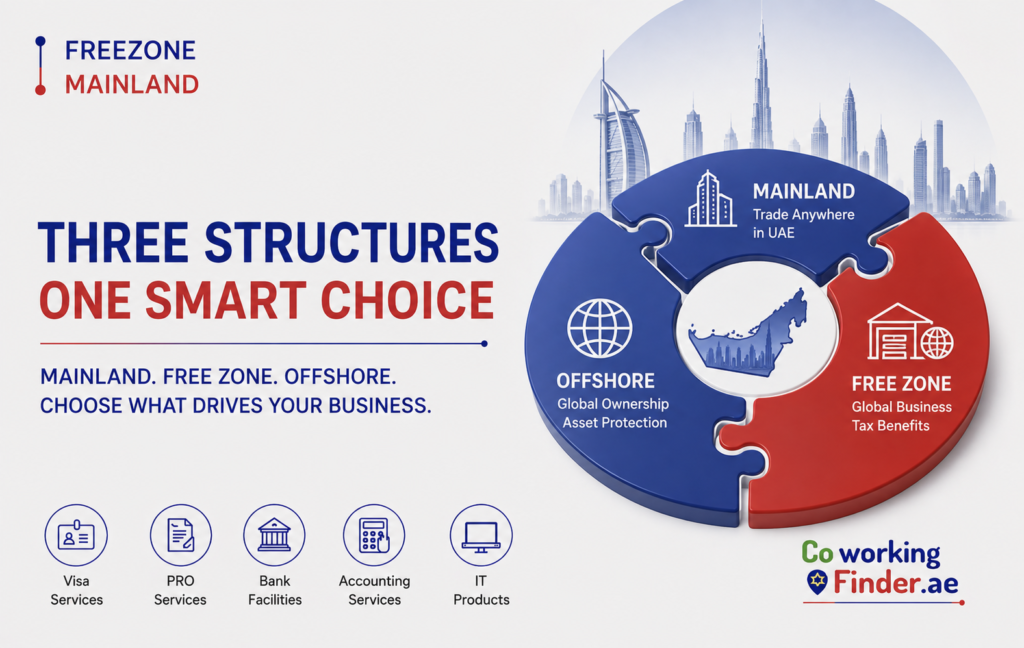
Anyone researching company formation UAE will run into three core structures. Picking between them is the single decision that shapes almost everything else — your costs, your customers, your tax exposure, and how easily you can expand later.
1. Mainland Company
A mainland company is licensed by the Department of Economic Development (DED) — or DET in Dubai — of the relevant emirate. This is the only structure that lets you trade freely anywhere in the UAE without a local distributor, bid on government contracts, and open branches across emirates. Mainland company formation UAE now permits 100% foreign ownership in most commercial and professional activities, a major shift from the old local-sponsor requirement. The trade-off: mainland entities generally need a physical, Ejari-registered office (a flexi-desk usually isn’t enough for licensing), and profits above AED 375,000 are taxed at the standard 9% corporate tax rate with no exemption route.
2. Free Zone Company
Free zones are purpose-built economic areas — over 40 of them across the UAE — each regulated by its own authority rather than the DED. A free zone company formation UAE package typically bundles a licence, a flexi-desk or shared office, and one or more investor visas into a single annual fee, which is why free zones remain the faster and usually cheaper entry point. The core limitation is market access: free zone companies generally cannot sell directly to UAE mainland customers without routing through a distributor or opening a mainland branch. In exchange, many free zone entities qualify for 0% corporate tax under the Qualifying Free Zone Person (QFZP) regime, provided they meet substance and income-type conditions.
3. Offshore Company
Offshore structures (such as JAFZA Offshore or RAK ICC) are built for holding assets, international trading, or owning property — not for operating a physical business inside the UAE. They can’t sponsor employee visas or lease local office space, but they’re inexpensive, quick to register, and useful for founders who need a UAE-based holding entity for international structuring rather than day-to-day trading.
| Quick read: choose mainland if your customers are inside the UAE; choose a free zone if you sell internationally or to other free zone companies and want 0% corporate tax; choose offshore only if you need a holding vehicle, not an operating business. |
Step-by-Step: How Company Formation UAE Actually Works
Regardless of jurisdiction, company formation UAE follows a broadly similar sequence. Free zones move faster because approvals happen within a single authority; mainland setups involve more external departments.
- Choose your business activity — this single decision determines which authorities, licence type, and approvals you need, so it should come before you pick a free zone or emirate.
- Select your jurisdiction and legal structure — mainland LLC, free zone FZE/FZ-LLC, branch, or civil company, based on ownership, activity, and market access needs.
- Reserve a trade name and apply for initial approval from the DED or the chosen free zone authority.
- Draft and notarise your Memorandum of Association (MOA) — required for mainland LLCs and most multi-shareholder free zone entities.
- Secure your business address — an Ejari-registered office for mainland, or a flexi-desk/office package from the free zone.
- Pay licence fees and receive your trade licence — this is the point at which the company legally exists.
- Apply for the establishment card, then investor and employee visas, including Emirates ID and medical testing.
- Open a corporate bank account and register for corporate tax (and VAT, if turnover exceeds the AED 375,000 threshold).
Free zone companies are typically licensed within three to seven working days, with investor visa processing adding roughly ten to fifteen working days. Mainland company formation UAE usually takes seven to fourteen working days for the licence itself, plus additional time for external approvals depending on the activity — anywhere from two to four weeks end to end is a realistic planning window.
Company Formation UAE Cost: A Realistic 2026 Breakdown
Advertised “licence from AED 5,500” prices rarely reflect the real cost of company formation UAE, because they usually exclude the establishment card, visas, medical testing, Emirates ID, and bank account charges. Below is a more complete first-year picture.
| Cost Component | Free Zone (typical range) | Mainland (typical range) |
| Trade licence fee | AED 8,000 – 20,000 / year | AED 10,000 – 25,000 / year |
| Registration & establishment card | AED 2,000 – 5,000 (one-off) | AED 2,000 – 6,000 (one-off) |
| Office / flexi-desk | Often bundled in the package | AED 15,000+ (Ejari office mandatory) |
| Investor visa (per person) | AED 3,000 – 6,500 | AED 3,000 – 7,000 |
| Medical test & Emirates ID | AED 1,800 – 2,500 per visa | AED 1,800 – 2,500 per visa |
| Estimated first-year total | AED 18,000 – 40,000 | AED 25,000 – 50,000+ |
These figures move depending on the free zone, the number of visas, and the business activity — a fintech or media licence, for example, usually costs more than a general trading licence. The pattern that matters most for company formation UAE budgeting is this: free zones win decisively on entry-level cost and speed, while mainland costs more upfront but removes the ceiling on who you can sell to.
Corporate Tax and VAT: What Changed
The UAE introduced federal corporate tax in 2023: a 9% rate applies to taxable profits above AED 375,000, with 0% below that threshold. This applies to mainland companies without exception. Free zone companies can still qualify for a 0% rate on “qualifying income” under the Qualifying Free Zone Person regime, but only if they maintain adequate substance in the UAE, earn qualifying income (largely from outside the mainland or from other free zone entities), and keep audited financial statements. Get the QFZP conditions wrong and a free zone company can lose the exemption entirely for that tax period — which is why compliance advice matters as much as the initial company formation UAE paperwork.
VAT, separately, is charged at 5% once taxable turnover crosses AED 375,000 in a rolling 12-month period, and voluntary registration is available above AED 187,500. Both mainland and free zone companies are subject to VAT rules in the same way.
Comparing UAE Free Zones: SHAMS, Meydan, IFZA, DIFC & DMCC
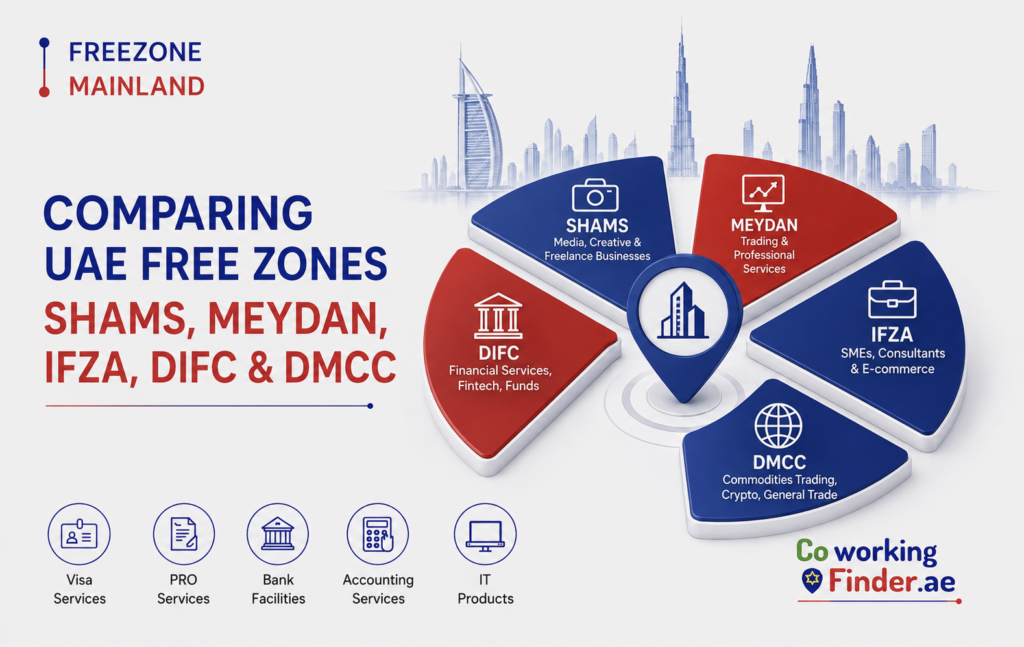
Not all free zones serve the same purpose, and picking the right one is as important to company formation UAE outcomes as the mainland-versus-free-zone decision itself. Here’s how five of the most searched-for options compare.
| Free Zone | Best For | Notable Strength |
| SHAMS (Sharjah) | Media, creative & freelance businesses | Low-cost entry packages, freelance permits |
| Meydan Free Zone | General trading & professional services | Fast digital licensing, flexi-desk included |
| IFZA (Dubai) | SMEs, consultants, e-commerce | Wide activity list, competitive package pricing |
| DIFC | Financial services, fintech, funds | Common-law jurisdiction, own courts |
| DMCC | Commodities trading, crypto, general trade | World’s largest free zone, strong global reputation |
SHAMS
Sharjah Media City, known as SHAMS, built its reputation on affordable licensing for media, creative, and freelance-style businesses. It’s a common starting point for solo founders and small teams doing company formation UAE on a tight first-year budget, with packages that scale up as the business grows.
Meydan Free Zone
Meydan Free Zone is a Dubai-based option popular for its largely digital application process and bundled flexi-desk packages, which cover multiple business activities under a single licence. It’s a practical middle-ground choice for founders who want mainland-adjacent credibility without mainland overhead.
IFZA
The International Free Zone Authority, or IFZA, operates out of Dubai Silicon Oasis and is one of the most price-competitive free zones for general trading, consulting, and e-commerce activities. Its broad activity list makes it a common pick for founders who aren’t yet sure exactly how their business will evolve.
DIFC
The Dubai International Financial Centre sits apart from the other zones on this list: it operates under its own common-law legal framework and courts, and is purpose-built for financial services, fintech, wealth management, and funds. Company formation UAE within DIFC costs more than a general-purpose free zone, but for regulated financial activity it’s often the only credible option.
DMCC
The Dubai Multi Commodities Centre, DMCC, is the largest free zone in the world by active company count and remains the default choice for commodities trading, crypto-related businesses, and general trade that wants a globally recognised address. It’s a heavier-weight (and pricier) option than SHAMS or IFZA, but the brand recognition can matter when dealing with international banks and partners.
Documents Required for Company Formation UAE
Paperwork requirements shift slightly by jurisdiction and activity, but most company formation UAE applications converge on a similar core document set. Having these ready before you approach a free zone authority or the DED shortens the process considerably.
- Passport copies of all shareholders and the appointed manager, valid for at least six months.
- Passport-sized photographs on a white background for each shareholder.
- A completed application form for the chosen free zone authority or DED.
- A brief business plan or activity description, especially for regulated sectors such as DIFC financial services.
- No Objection Certificate (NOC) from a current UAE sponsor, if any shareholder is already a UAE resident on another visa.
- Proof of residential address for shareholders, such as a recent utility bill or bank statement.
- Draft Memorandum and Articles of Association for multi-shareholder entities.
Missing or inconsistent documentation is one of the most common reasons company formation UAE applications stall at the initial approval stage, so a short document audit before submission is worth the extra day it takes.
Company Formation UAE by Business Type
The “right” jurisdiction for company formation UAE depends heavily on what you actually sell. Below are the patterns that tend to hold across the founders and businesses we see most often.
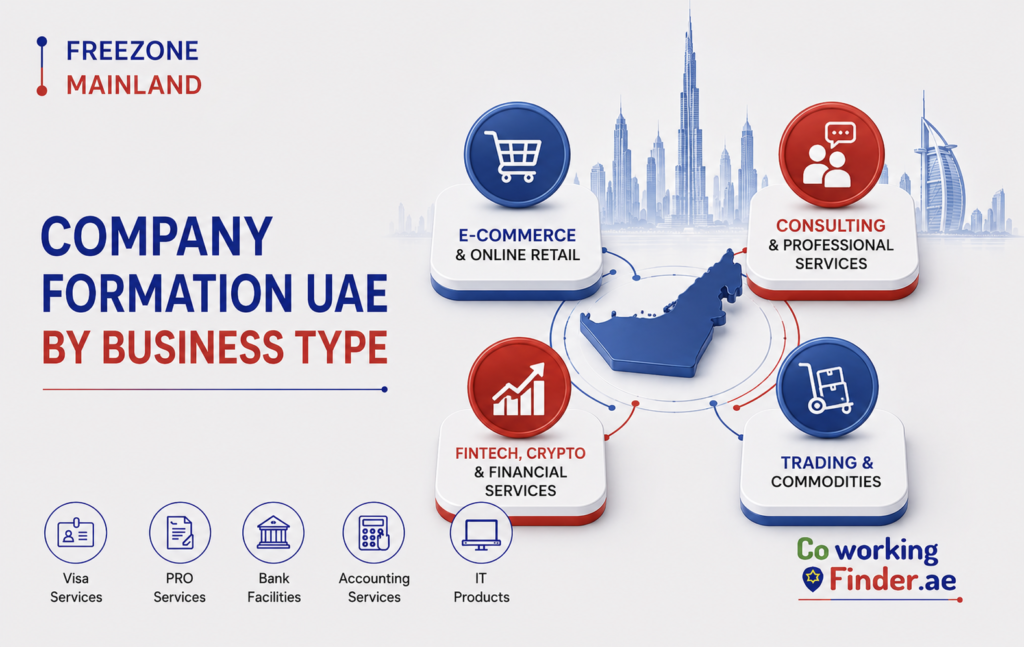
E-commerce and Online Retail
E-commerce founders pursuing company formation UAE typically lean toward free zones like IFZA or Meydan Free Zone, which offer e-commerce-specific activity codes, competitive package pricing, and enough flexibility to add warehousing or fulfilment activities later. A mainland licence only becomes necessary once you need a physical retail presence or direct fulfilment to mainland customers at scale.
Consulting and Professional Services
Consultants, agencies, and freelancers make up a large share of company formation UAE activity because the entry cost is low and most free zones — SHAMS and IFZA in particular — offer dedicated freelance or single-shareholder professional licence packages. A flexi-desk is usually sufficient, and visa needs are typically limited to the founder plus one or two staff.
Fintech, Crypto, and Financial Services
Regulated financial activity is the one area of company formation UAE where the jurisdiction choice is largely made for you: DIFC (and to a lesser extent DMCC for certain crypto and commodities-adjacent activities) offers the licensing categories, regulator relationships, and common-law legal framework that banks and institutional partners expect to see. Trying to run a regulated fintech product through a general-purpose free zone usually creates banking and compliance friction later.
Trading and Commodities
General trading businesses — import/export, wholesale, commodities — gravitate toward DMCC or Meydan Free Zone for company formation UAE, both of which offer trading-specific activity lists, warehousing partnerships, and, in DMCC’s case, a globally recognised address that eases supplier and banking relationships.
Opening a Corporate Bank Account After Company Formation UAE
Banking is frequently the slowest step in company formation UAE, and it’s worth planning for separately from the licensing timeline. UAE banks have tightened onboarding requirements in recent years, and a newly formed company with no trading history is scrutinised more closely than an established one. Most banks will ask for the trade licence, shareholder passports and visas, a clear description of business activity, expected transaction volumes, and — increasingly — a short business plan or website. Free zone companies without a UAE-resident shareholder sometimes face longer review periods, so applying for the corporate account as soon as the licence is issued, rather than waiting, is the more reliable approach.
Renewal and Ongoing Compliance Calendar
Company formation UAE doesn’t end at licensing — it’s a recurring commitment. Trade licences, office tenancy (or flexi-desk packages), and investor visas all renew annually, and missing a renewal window can trigger fines or licence suspension. Corporate tax returns are due within nine months of the end of the relevant financial year, and VAT-registered companies file on a quarterly or monthly cycle depending on turnover. Building a simple renewal calendar at the point of company formation UAE — licence date, visa expiry dates, tax filing deadlines — avoids the scramble that catches many first-time founders in year two.
Common Mistakes in Company Formation UAE
- Choosing a free zone purely on price before confirming it covers your intended business activity.
- Assuming a free zone licence lets you invoice UAE mainland clients directly — it usually doesn’t without a distributor or mainland branch.
- Underestimating renewal costs: year-two fees, office renewal, and visa renewals are recurring, not one-off.
- Skipping proper Ejari registration for mainland offices, which can delay licence renewal and visa processing.
- Overlooking QFZP substance requirements and losing the 0% corporate tax rate as a result.
- Opening a corporate bank account as an afterthought — banks increasingly ask for business plans and proof of activity before approving accounts for new entities.
Getting Compliant Company Formation UAE Support
Because so much of company formation UAE now hinges on getting the tax position right — not just the licence — most founders bring in a compliance partner rather than handling registration alone. Olive & Tanami, a Dubai-based business setup and compliance consultancy, works with founders through the full process: comparing mainland versus free zone jurisdictions against your actual business model, structuring the application for corporate tax and QFZP eligibility from day one, and handling the licensing, visa, and bank account steps end to end. That kind of hands-on compliance support is often the difference between a company formation UAE process that takes two weeks and one that drags into months over avoidable paperwork issues.
Frequently Asked Questions
How much does company formation UAE cost in 2026?
A free zone company typically costs AED 18,000 to AED 40,000 for the first year including licence, one visa, and a flexi-desk. Mainland company formation UAE usually runs AED 25,000 to AED 50,000 or more once an Ejari office and visa costs are included, largely because a physical office is mandatory.
Can a foreigner own 100% of a company in the UAE?
Yes. Free zones have always allowed 100% foreign ownership, and reforms to the Commercial Companies Law now extend 100% foreign ownership to most mainland activities as well, removing the old requirement for a local Emirati sponsor in the majority of sectors.
How long does company formation UAE take?
Free zone licences are usually issued within three to seven working days. Mainland company formation UAE typically takes seven to fourteen working days for the licence, with the full process — including visas — often taking two to four weeks.
Which is better for company formation UAE: mainland or free zone?
It depends on who you sell to. If your customers are mainly inside the UAE, mainland gives unrestricted market access. If you sell internationally or to other free zone companies, a free zone with QFZP-qualifying income can offer 0% corporate tax and a faster, cheaper setup.
Do free zone companies pay corporate tax?
Free zone companies can qualify for 0% corporate tax on qualifying income under the QFZP regime, but only if they meet substance requirements and keep audited financial statements. Non-qualifying income is taxed at the standard 9% rate above the AED 375,000 threshold, the same as mainland.
Do I need a local sponsor for company formation UAE?
In most cases, no. Free zones have never required a local sponsor, and mainland reforms now allow 100% foreign ownership across the majority of commercial and professional activities. A small number of strategically sensitive sectors still require Emirati participation.
Mainland or Free Zone: A Quick Decision Framework
If you’re still weighing structures, it helps to reduce company formation UAE to three questions before comparing individual free zones.
- Who invoices you? If most revenue comes from UAE mainland customers, mainland company formation UAE is usually the more durable choice, even at a higher entry cost.
- Do you need QFZP-qualifying income? If your customers are outside the UAE or in other free zones, a free zone structure can deliver 0% corporate tax — but only with proper substance and bookkeeping in place.
- How fast do you need to launch? Free zone company formation UAE is typically the quicker path, often licensed within a week, which matters if you’re closing a deal or opening a bank account against a deadline.
Running through these three questions before comparing SHAMS, Meydan Free Zone, IFZA, DIFC, or DMCC against each other tends to narrow the shortlist to one or two realistic options quickly, rather than starting from a list of forty-plus free zones with no filter.
Final Thoughts
Company formation UAE isn’t a single checklist — it’s a set of interlocking decisions about structure, jurisdiction, tax position, and long-term market access. Free zones like SHAMS, Meydan Free Zone, IFZA, DIFC, and DMCC each serve a different kind of founder, mainland remains the only route to unrestricted UAE sales, and corporate tax now makes the compliance side of setup as important as the licensing itself. Getting informed before you file — and pairing that research with proper compliance support from a partner like Olive & Tanami — is what turns company formation UAE from a paperwork exercise into a foundation that actually supports growth.
