

Ejari Registration Dubai (2026): Complete Process, Fees & Documents Guide
If you’ve just signed a tenancy contract in Dubai whether for a home or a business address Ejari registration Dubai is the single step that turns that contract into something the government, your utility provider, and your bank will actually recognise. Skip it, and you can’t connect DEWA, sponsor a residence visa, license a business at that address, or take a landlord dispute to court. It sounds like a formality until the week you need it and don’t have it.
This guide covers everything involved in Ejari registration Dubai in 2026: what Ejari actually is, the exact fees and documents required, the step-by-step registration process (both online and in person), how renewal and cancellation work, and — because so many readers researching this topic are setting up a business rather than renting a home — how Ejari connects directly to trade licensing, especially for mainland companies.
This is also why Ejari registration Dubai comes up so often in company formation guides, even though it’s technically a real-estate process rather than a licensing one: the two are tied together administratively for every mainland business, and treating Ejari registration Dubai as a side errand rather than a core milestone is where most timeline slippage happens.
Table of Contents
What Is Ejari, and Why Does It Matter?
Ejari — Arabic for “my rent” — is the tenancy registration system run by the Dubai Land Department (DLD) and regulated by RERA, the Real Estate Regulatory Agency. Introduced in 2010, it standardised what used to be a fragmented, paper-based rental market by requiring every tenancy contract in Dubai to be logged in a single official register. Once registered, your lease receives a unique Ejari number and certificate that authorities, banks, and service providers treat as proof that the tenancy is real and legally recognised.
Ejari registration Dubai isn’t optional for anyone renting property in the emirate, residential or commercial. Without it, you’re operating outside the system RERA built specifically to protect both tenants and landlords — which means no legal recourse if a dispute arises, and no ability to access the services that depend on a registered lease.
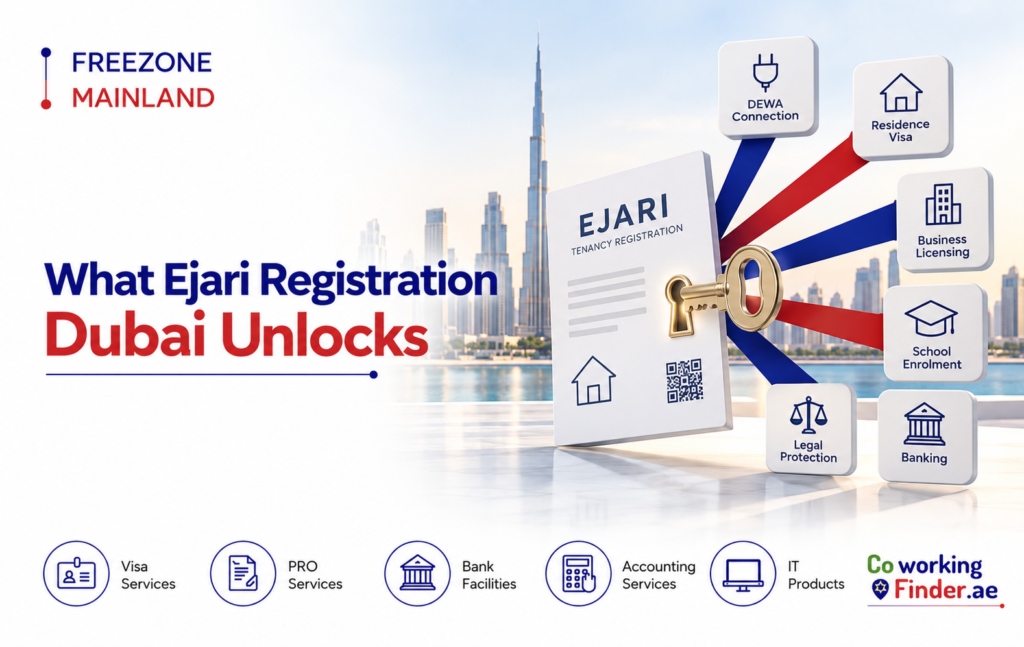
What Ejari Registration Dubai Unlocks
The certificate itself is simple, but the list of things that depend on it is long. This is usually what makes Ejari registration Dubai a priority rather than an afterthought.
- DEWA connection — Dubai Electricity and Water Authority will not activate a new water or electricity account without a valid Ejari certificate tied to the tenant’s name.
- Residence visa sponsorship — immigration authorities require proof of a registered address before approving family or dependent visa applications.
- Business licensing — mainland companies must submit an Ejari certificate for their office address as part of trade licence issuance and renewal.
- School enrolment — many schools ask for a copy of the tenant’s Ejari certificate as proof of residence in the relevant catchment area.
- Legal protection — a registered tenancy contract is enforceable in the Dubai Rental Disputes Settlement Centre; an unregistered one generally is not.
- Banking — some banks request an Ejari certificate as part of address verification for account opening or mortgage applications.
| In short: no Ejari registration Dubai, no utilities, no dependent visas, and no legal standing if a rental dispute goes to court. It’s a non-negotiable step, not paperwork you can defer. |
Ejari Registration Dubai: Fees in 2026
Costs are modest but vary slightly depending on where you register. Government portals and the Dubai REST app charge the base fee only, while typing centres and document clearing services add a small handling charge.
| Fee Component | Approx. Cost (AED) |
|---|---|
| Base Ejari registration fee | 155 |
| Knowledge fee | 10 |
| Innovation fee | 10 |
| Typing centre / service charge (if applicable) | 20 – 60 |
| Total via Dubai REST app / DLD portal | 177 – 200 |
| Total via typing centre or PRO service | 215 – 300 |
Renewal costs the same as new Ejari registration Dubai, since the system treats a renewal as a fresh registration of the (updated) tenancy contract. If you’re setting up through a business setup consultancy or PRO service as part of a company formation package, expect an additional service fee on top of the government charges — usually AED 150 to 300 — in exchange for the paperwork being handled for you.
Documents Required for Ejari Registration Dubai
Gathering the right paperwork before you start is the single biggest factor in how smoothly Ejari registration Dubai goes. Missing or mismatched details — a name spelled differently on two documents, for instance — is the most common reason applications get rejected or delayed.
- Original, signed tenancy contract between landlord and tenant.
- Landlord’s title deed or a copy of it, showing the property is registered.
- Tenant’s Emirates ID (front and back) or passport copy with a valid UAE residence visa page.
- DEWA premise number for the property, found on a previous bill or from the landlord.
- Passport-sized photo, in some cases, for first-time individual registrations.
- Trade licence copy and Memorandum of Association, if registering a commercial or office tenancy for a business.
- Security deposit receipt or proof of payment, where requested by the typing centre or DLD.
For commercial tenancies tied to company formation, the trade licence and MOA are what link the Ejari certificate back to the business itself — this is the document trail that DED and free zone authorities check when a mainland company applies for or renews its licence.
How to Complete Ejari Registration Dubai: Step by Step
There are two practical routes: the fully digital Dubai REST app, or an in-person visit to an authorised Ejari typing centre or Real Estate Services Trustee office. Both lead to the same certificate; the difference is speed and convenience.
Option 1: Register Online via Dubai REST
- Download the Dubai REST app (Dubai Land Department) or log in via the DLD’s Ejari web portal.
- Sign in using UAE Pass, or create an account if you’re a first-time user.
- Select the Ejari registration service and enter the tenancy contract details — property number, DEWA premise number, and rent value.
- Upload scanned copies of the required documents listed above.
- Pay the registration fee through the app.
- Receive your Ejari certificate, typically within one to two business days once documents are verified.
Option 2: Register In Person at a Typing Centre
- Locate an authorised Ejari registration centre — these are commonly attached to DLD offices or licensed real estate typing centres across Dubai.
- Bring physical or printed copies of all required documents.
- Complete the Ejari registration form with staff assistance, who will also verify your documents on the spot.
- Pay the registration fee, usually by card.
- Collect your printed Ejari certificate immediately, or have it emailed once processed.
Working with a typing centre or a compliance consultancy costs slightly more than the app, but it’s often the more reliable route if your documents are unusual — a company tenancy, a joint lease, or a first-time landlord who hasn’t registered a property before.
Ejari Renewal: What Changes Each Year
Ejari certificates run alongside the tenancy period, which in Dubai is typically one year. Renewal is required before the certificate’s expiry date to avoid a gap that can disrupt DEWA billing, visa renewals, or licence renewals tied to the same address.
- Check your certificate’s expiry date in advance, either on the document itself or by logging into the Dubai REST app.
- Gather an updated tenancy contract if the rent value or lease term has changed.
- Submit the renewal through the same channel — app or typing centre — using largely the same document set as the original registration.
- Pay the renewal fee, which mirrors the new-registration fee rather than being discounted.
- Download the renewed certificate once processed.
If the lease has been extended for more than a single year, renew Ejari to match the new term rather than letting it lapse and re-registering later — a lapsed Ejari certificate can complicate DEWA continuity and any pending visa or licence renewal.
Cancelling an Ejari Certificate
Cancellation becomes necessary when a tenant moves out, a lease ends early, or a landlord changes. The process requires the landlord’s consent in most cases, since the certificate reflects an agreement between both parties.
- Obtain written consent from the landlord confirming the tenancy is ending.
- Log into the Ejari portal or visit a typing centre with the original certificate and landlord consent.
- Settle any outstanding DEWA bills tied to the property before cancellation is finalised.
- Submit the cancellation request; processing is typically completed within a day.
Skipping this step when moving out can leave a tenant technically registered at an address they no longer occupy — which occasionally causes confusion during a subsequent visa or licence application at a new location.
Ejari Registration Dubai for Business Owners: Mainland vs Free Zone
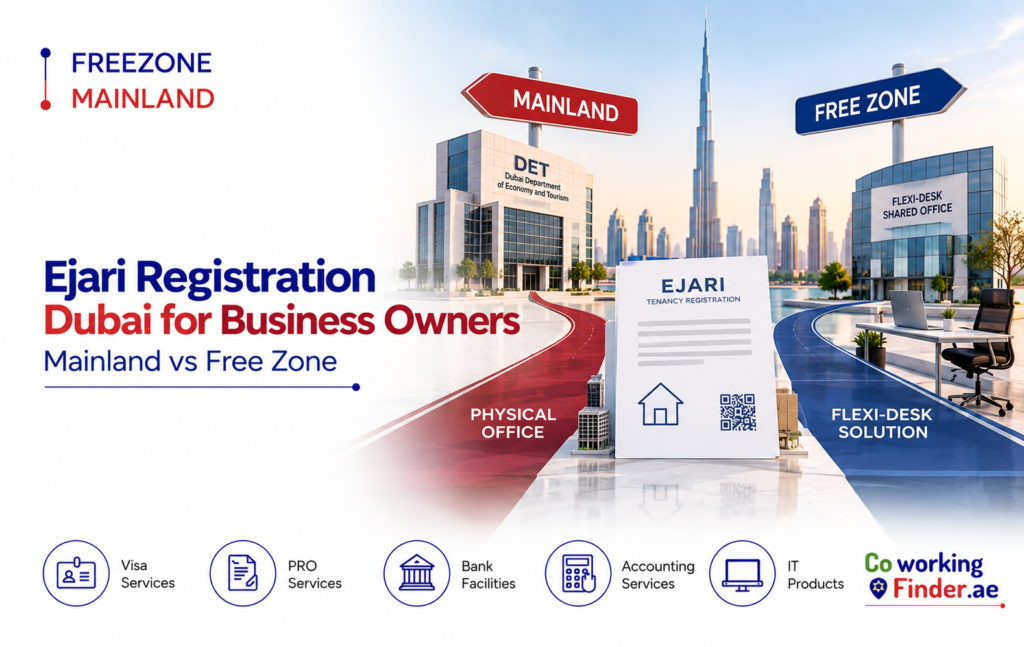
This is where Ejari registration Dubai intersects directly with company formation. Mainland companies — those licensed by the Dubai Department of Economy and Tourism (DET) — are required to register a physical, Ejari-backed office tenancy as part of trade licence issuance and every subsequent renewal. Without a valid Ejari certificate for the business address, a mainland trade licence simply cannot be renewed.
Free zone companies work differently. Most free zones bundle a flexi-desk or shared office into the licence package itself, which means the founder typically doesn’t need to separately complete Ejari registration Dubai — the free zone authority handles the tenancy arrangement internally as part of the licence. This is one of the practical reasons founders who want to avoid the Ejari and physical-office requirement altogether often choose a free zone structure instead of mainland.
| Structure | Ejari Requirement | Typical Office Arrangement |
|---|---|---|
| Mainland (DET-licensed) | Mandatory — required for licence issuance and renewal | Physical office with signed, Ejari-registered tenancy |
| Free zone | Not required directly — handled within the free zone package | Flexi-desk or shared office bundled into the licence |
| Offshore | Not applicable — no physical UAE office permitted | No local office; used for holding/international structuring |
If a flexi-desk model appeals more than the Ejari-and-physical-office route, several UAE free zones are worth comparing directly:
SHAMS (Sharjah Media City) offers low-cost licensing with a bundled desk, popular with freelancers and media businesses that want to sidestep Ejari registration Dubai entirely.
Meydan Free Zone bundles a flexi-desk into most packages and processes applications largely online, making it a fast alternative to a mainland Ejari-backed office.
IFZA in Dubai Silicon Oasis offers a wide range of activities under a similar flexi-desk model, avoiding the need for a separate tenancy registration.
DIFC is built for regulated financial services and provides its own office and leasing framework outside the standard Ejari system.
DMCC — the world’s largest free zone — likewise bundles office solutions into its licence packages rather than requiring standalone Ejari registration Dubai.
None of this means Ejari is something to avoid on principle — mainland licensing has real advantages, including unrestricted access to sell within the UAE. It simply means the office and tenancy question is one more variable to weigh alongside tax and market access when comparing mainland against a free zone.
Ejari Registration Dubai vs Other Emirates
Ejari is specific to Dubai — it’s run by the Dubai Land Department and doesn’t extend to other emirates. Abu Dhabi operates its own tenancy system called Tawtheeq, run by the Abu Dhabi Department of Municipalities and Transport, while Sharjah, Ajman, and the Northern Emirates have their own, generally less digitised registration processes. If you’re comparing office locations across emirates as part of a company formation decision, it’s worth knowing that Ejari registration Dubai specifically only applies within Dubai’s jurisdiction — a Sharjah or Abu Dhabi tenancy will follow a different system with its own fees and documentation, even if the overall purpose (recognising the lease officially) is the same.
Who Handles Ejari Registration Dubai: Landlord or Tenant?
In practice, either party can initiate Ejari registration Dubai, though it’s most commonly done by the tenant or their appointed agent, since the tenant is usually the one who needs the certificate for DEWA, visas, or a business licence. Landlords are generally cooperative because a registered tenancy also protects their side of the agreement and is often a precondition for property management services or mortgage compliance. In the rare case of an uncooperative landlord, Dubai’s rules allow tenant-initiated registration using the property’s title deed number, obtainable from the Dubai Land Department, though the process typically takes longer without the landlord’s active participation.
Ejari Registration Dubai for Different Property Types
The core process for Ejari registration Dubai stays the same across property types, but a few details shift depending on what’s being registered.
Residential Tenancies
Standard apartment or villa rentals are the most common Ejari registration Dubai use case, requiring the tenancy contract, Emirates ID or passport with residence visa, and the DEWA premise number. This is also the version most often tied to family visa sponsorship and school enrolment.
Commercial and Office Tenancies
Business tenancies add the trade licence and Memorandum of Association to the standard document set, since the certificate needs to be traceable back to the licensed company rather than an individual. This is the version that matters most for mainland company formation, where the office lease and the trade licence are directly linked.
Industrial and Warehouse Tenancies
Industrial and warehouse leases follow a similar Ejari registration Dubai process but may require additional approvals from the relevant free zone or municipal authority depending on the activity — particularly for storage of regulated goods, where extra permits sit alongside the standard tenancy registration.
Ejari and the Dubai Rental Increase Calculator
A registered Ejari certificate is also what makes Dubai’s rental increase rules enforceable. RERA’s rental index sets the maximum percentage a landlord can raise rent at renewal, based on how far the current rent sits below the market average for similar properties. Because that calculation depends on the rent value recorded in your Ejari certificate, keeping your registration accurate and up to date isn’t just a compliance formality — it’s what protects you from an unlawful rent increase at renewal time. Tenants who skip Ejari registration Dubai, or let it lapse, lose the paper trail that RERA’s dispute centre relies on if a landlord tries to raise rent beyond the permitted limit.
Ejari Registration Dubai and the Dubai REST App: A Closer Look
The Dubai REST app is the Dubai Land Department’s official platform, and it’s worth spending a few minutes inside it before starting Ejari registration Dubai for the first time. Beyond the registration form itself, the app lets you check an existing certificate’s status, download a digital copy at any time, and track renewal deadlines without needing to visit a centre in person. For tenants who move frequently or manage more than one property — landlords included — this dashboard view is often the fastest way to keep multiple Ejari registrations current without missing a renewal window.
One detail that trips up first-time users: the app requires UAE Pass for full functionality, which itself needs an Emirates ID and a registered mobile number to set up. If you’re new to the UAE and haven’t activated UAE Pass yet, budget an extra day for that step before attempting Ejari registration Dubai online — it’s faster in the long run than defaulting to a typing centre out of frustration with the login process.
How Ejari Registration Dubai Fits Into a Company Formation Timeline
For founders going through mainland company formation, Ejari registration Dubai typically sits toward the middle of the process — after initial trade name approval and activity selection, but before the final trade licence is issued. The sequence usually looks like this: secure the office space, sign the tenancy contract, complete Ejari registration Dubai, then submit the certificate alongside the trade licence application. Skipping ahead and applying for the licence before the Ejari certificate is ready is one of the most common causes of last-minute delays in an otherwise smooth mainland setup, since the DED or DET simply won’t issue the licence without proof of a registered office.
Founders who plan this sequence lining up the office and starting Ejari registration Dubai as soon as the trade name is approved, rather than after generally get through mainland licensing noticeably faster than those who treat the tenancy step as an afterthought.
Common Mistakes That Delay Ejari Registration Dubai
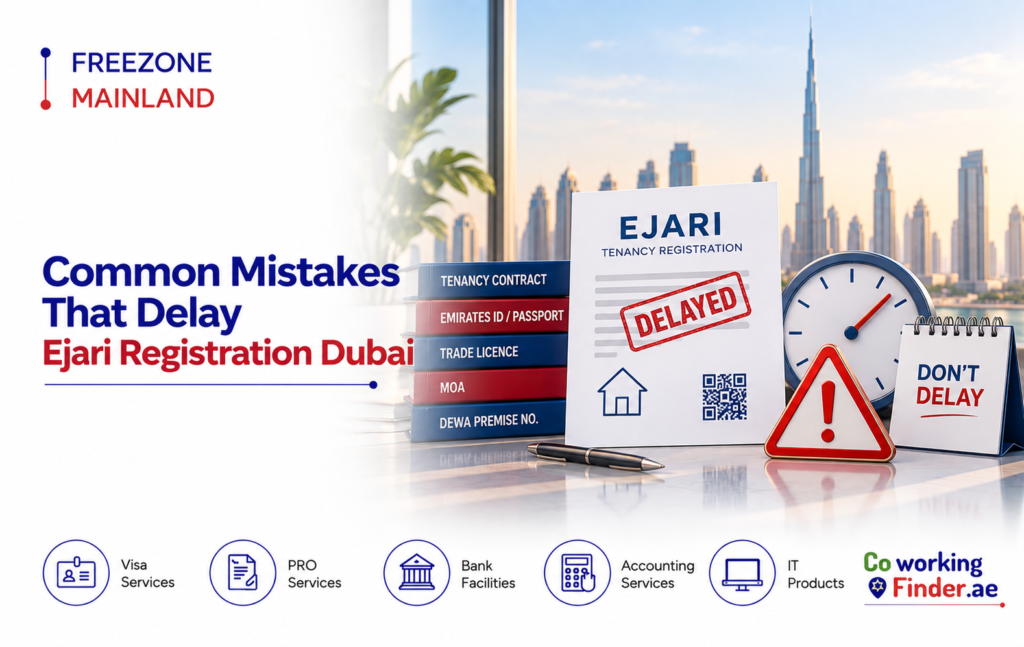
- Submitting a tenancy contract with a name that doesn’t exactly match the Emirates ID or passport on file.
- Forgetting the DEWA premise number, which is required even before utilities are connected.
- Registering a commercial tenancy without the trade licence and MOA on hand, which stalls business-related Ejari applications.
- Letting the certificate lapse before renewal, disrupting DEWA billing or a licence renewal timeline.
- Assuming a free zone flexi-desk requires the same Ejari process as a mainland office, and losing time chasing paperwork the free zone authority already handles.
- Not keeping the payment receipt and certificate together, which some government departments ask for as a pair during visa or licence checks.
The lesson holds across every scenario in this guide: Ejari registration Dubai is small enough to complete in a day, and disruptive enough to cost weeks if it’s ignored.
Getting Professional Support
Because Ejari registration Dubai sits at the intersection of tenancy law, DEWA activation, and business licensing, many tenants and founders prefer not to navigate it alone — particularly when a company’s trade licence renewal is riding on getting the paperwork right. Olive & Tanami, a Dubai-based business setup and compliance consultancy, handles Ejari registration and renewal as part of its wider company formation and compliance support — coordinating the tenancy registration, DEWA activation, and licence renewal together so nothing stalls because one certificate expired before another was submitted. For business owners weighing whether to register Ejari for a mainland office or move to a free zone’s bundled desk instead, that kind of joined-up advice is usually worth more than the fee it costs.
Frequently Asked Questions
How much does Ejari registration Dubai cost in 2026?
Ejari registration Dubai typically costs AED 177 to 200 through the Dubai REST app or DLD portal, or AED 215 to 300 through a typing centre once service charges are included. The base government fee is around AED 155, plus small knowledge and innovation fees.
What documents do I need for Ejari registration Dubai?
You’ll need the signed tenancy contract, the landlord’s title deed, your Emirates ID or passport with a valid residence visa, and the property’s DEWA premise number. Business tenancies also require a trade licence copy and Memorandum of Association.
How long does Ejari registration Dubai take?
Online registration through the Dubai REST app is usually processed within one to two business days. In-person registration at a typing centre can produce a certificate the same day once documents are verified.
Do free zone companies need Ejari registration Dubai?
Generally no. Free zones such as SHAMS, Meydan Free Zone, IFZA, DIFC, and DMCC bundle office or flexi-desk arrangements into the licence package itself, so the founder typically doesn’t complete a separate Ejari registration the way a mainland company must.
What happens if I don’t complete Ejari registration Dubai?
Without a valid Ejari certificate, DEWA won’t activate electricity and water, immigration won’t approve dependent visas tied to that address, mainland trade licences can’t be renewed, and the tenancy contract has no legal standing in a rental dispute.
How do I renew my Ejari certificate?
Renewal is completed through the same Dubai REST app or typing centre used for the original registration, using an updated tenancy contract if terms have changed. The renewal fee mirrors the original registration fee and should be completed before the certificate’s expiry date.
First-time renters and first-time business owners tend to make the same mistake with Ejari registration Dubai: assuming it’s a quick formality that can wait until something else forces the issue. In practice, treating Ejari registration Dubai as a priority from day one — the moment the tenancy contract is signed — is what keeps DEWA, visas, and licensing on schedule rather than stalled.
Final Thoughts
Ejari registration Dubai is one of the smallest-looking steps in setting up a home or a business in the emirate, and one of the most consequential if it’s ignored. It underpins utilities, visas, legal protection, and — for mainland companies — the trade licence itself. Whether you handle it yourself through the Dubai REST app or bring in support from a consultancy like Olive & Tanami, the practical advice is the same: complete Ejari registration Dubai the moment your tenancy contract is signed, not the week a bank, a school, or a licence renewal asks for it.
:%20Complete%20Process,%20Fees%20&%20Documents%20Guide)